Do you know how many “weight-loss habits” there are? When you ask Google (you know, THE authority on ANY topic) you will find 34 million or so articles to tell you what to do, what not to do, common advice that is bad, etc. Ask 100 people what the one habit is that makes someone successful at long term, sustained weight loss, and you will get nearly 100 answers. So how can you really know what you NEED to do to lose weight?
To be fair, a habit is sort of nebulously defined. I think we can all agree that a habit is anything you do regularly, but according to the definition used in psychology, a habit also needs to be done automatically — as in, without really thinking about it. Which is why identifying habits by yourself is so hard. How can you think about the stuff that you don’t have to think about?
You see, all habits need a trigger — a little reminder that says, “Hey, you should do this action now.” They also need a reward — a little reminder that what you just did was a good thing. But these are really hard to identify by yourself because they happen below our level of consciousness. It’s really hard to remember new triggers, and it’s hard to remember to reward yourself. Habits are hard. Isn’t crazy that bad habits seem to sneak up on you, while the healthy habits are so hard to keep? This one habit makes all the other healthy habits easy. So without further ado, The Number 1 Habit You Need to Lose Weight is:
FINDING PEOPLE TO SHARE YOUR JOURNEY
Permanent lifestyle changes happen in relationships. Whether they take place with peers, a coach, family, friends, coworkers, the other anonymous people at the meetings, or the participants in one of my healthy living challenges, new habits happen when people get together and help each other out.
Finding your own triggers is hard. Seeing other people’s is easy. Remembering to tell yourself, “Great job!” is hard. Remembering to tell other people is easy. Figuring out how to work new foods, new activities, and new steps into your own life is hard. Watching and learning from a whole bunch of other people like you who are trying to get to the same place you are is just so much easier!
This all-important, Number 1 habit can also be called, “Creating a community of consistency.” And it can be as big a commitment as hiring a coach, or as simple as telling a friend what you’re doing to lose weight or inviting them to join you in a Team Quadzilla Healthy Living Challenge. Whatever you can do to share the load of learning, planning, remembering and rewarding will be one less thing you have to worry about.
Life is meant to be lived in community with others. In today’s virtual world people can easily connect with one another even though there are many miles between them. People are looking for others with the same struggles so they can relate, find encouragement and help, and to be a help to others. That’s a key reason why I started Team Quadzilla. We are all on a journey to do what is right and to be our best. If you are struggling to make progress in your journey, whether physically, mentally/ emotionally, or spiritually let this be your encouragement to find a community to plug into.
Special thanks to Coach Stevo for doing the heavy lifting on this article. Coach Stevo is the nutrition and behavior change consultant at San Francisco CrossFit. He is a Certified Strength and Conditioning Specialist, holds a BA in Philosophy from the University of Chicago and an MA in Sport Psychology from John F. Kennedy University. He teaches habit-based coaching to wellness professionals all over the world and he contributed to Intervention by Dan John in 2012.
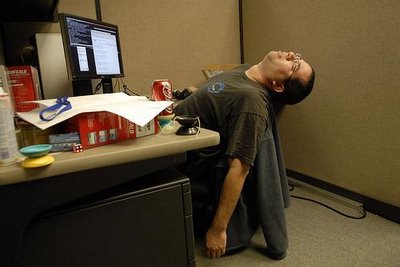
Every Desk Jockey understands the stiff and sleepy feeling that hits around 2:30 nearly every afternoon. Sitting all day staring at the screen and banging away on the keyboard is exhausting and potentially hazardous to your health.*
To save us from looking like the guy pictured above, I made a video of a very short and simple routine you can do at your desk to loosen your stiff muscles, increase your blood & oxygen flow, and wake you out of the afternoon coma.
Stretches
Neck Roll
Shoulder Roll
One Arm Hug
Overhead Side Stretch
Triceps stretch
Shoulder Blade Squeeze
Spinal Twist
Hand/ Wrist Stretch
Quads & Hammy Stretch
Strength
Desk Dips
Desk Pushups
Seated Leg Lift
Chair Squat
Forward Lunge
Tippy Toes
One Leg Balance
Wall Sit
Coach tips:
Set a recurring appointment on your calendar every afternoon for 10 minutes to go through this routine. It is sure to help you power through the rest of your day.
Invite your cubical neighbors to join you. Though I don’t think it looks silly to do these moves on your own, it will be super cool to have a small group Deskercising together. All the cool kids are doing it!
Skip the caffeine fix and sugary snacks. These will spike your blood sugar for 20 minutes, but then you crash again which makes you feel more tired and hungry than before. Instead, go for a big drink of water or a piece of whole fruit for your afternoon snack.
Remember that healthy and alert employees are more productive. In fact, your health is part of your job. Don’t feel guilty about taking this short break because you are too busy. Your boss will thank you for taking care of yourself so you can keep doing quality work.
Deskercise is a great help to the afternoon slump, but it is not a replacement for regular exercise. Target 30 mins of moderate to intense exercise 4-5 times a week for best results. Get access to 100’s of world-class fitness programs from yoga to dance to weightlifting that you can do at home by clicking HERE.
*While some research suggests that “sitting is the new smoking”, other research argues that maybe sitting isn’t as bad as we think. However, virtually all research agrees that people in general are far less physically active than previous generations and we need to move more to optimize our health. I agree. Let’s get moving people!
All runners have preferences regarding their run gear, especially when it comes to shoes. Since every runner is different and every foot is different, it stands to reason there will be literally hundreds of different shoes to choose from. With all the choices, it can be confusing to know what shoes you “should” be running in.
In my opinion, there is no perfect shoe. Shoe technology has advanced so much in recent years that if you are looking at shoes that retail over $100 (never pay retail price BTW – more on that later), there is a pretty good chance they will work for you so long as you consider a couple basic elements. I can hear the shoe nerds and run geeks now, “Blasphemy!”
Fit
Let’s not make fit more complicated than it needs to be. Are the shoes comfortable or not? Sometimes it’s hard to tell when you are trying them on for the first time. A really cool looking shoe on sale that doesn’t fit just right at first will not likely fit better the more you wear them. Trust me on this. Oh yeah, just because a certain shoe fit you well does not guarantee the new model of the same shoe will. Don’t force the fit. One more thing: If you are new to running, I highly recommend visiting a real running shop. Not a department store, but a shoe store that specializes in running. Have someone watch you walk and run, get your gait analyzed, and heed their recommendations for the type of shoes that would suit your foot best. This should be a free service.
Drop
A measurement in mm from the heel to the toe is called the drop. The higher the number, the bigger the “heel” padding of the shoe. Low drop shoes can also be called minimalist or racing or flats. Most average runners like me prefer shoes with more than minimalist padding, but everyone is different.
Intended Use
Some shoes are made for trail running, winter running, track sprinting, ultra-marathons, and everything in between. They will usually be described as such. Don’t buy track flats because they are cool looking and on sale if you intend to do winter trail running. You can generally trust the shoes description. Buy shoes that align with your primary run surface and distance.
Appearance
This is simply personal preference, but it’s still important. I’ve learned that I’m not going to find the perfect color shoes to go with my outfits and I don’t care. In fact, it seems to be the trend now to have wildly contrasting colors to your shoes. I embrace the color clash now. To each his own.
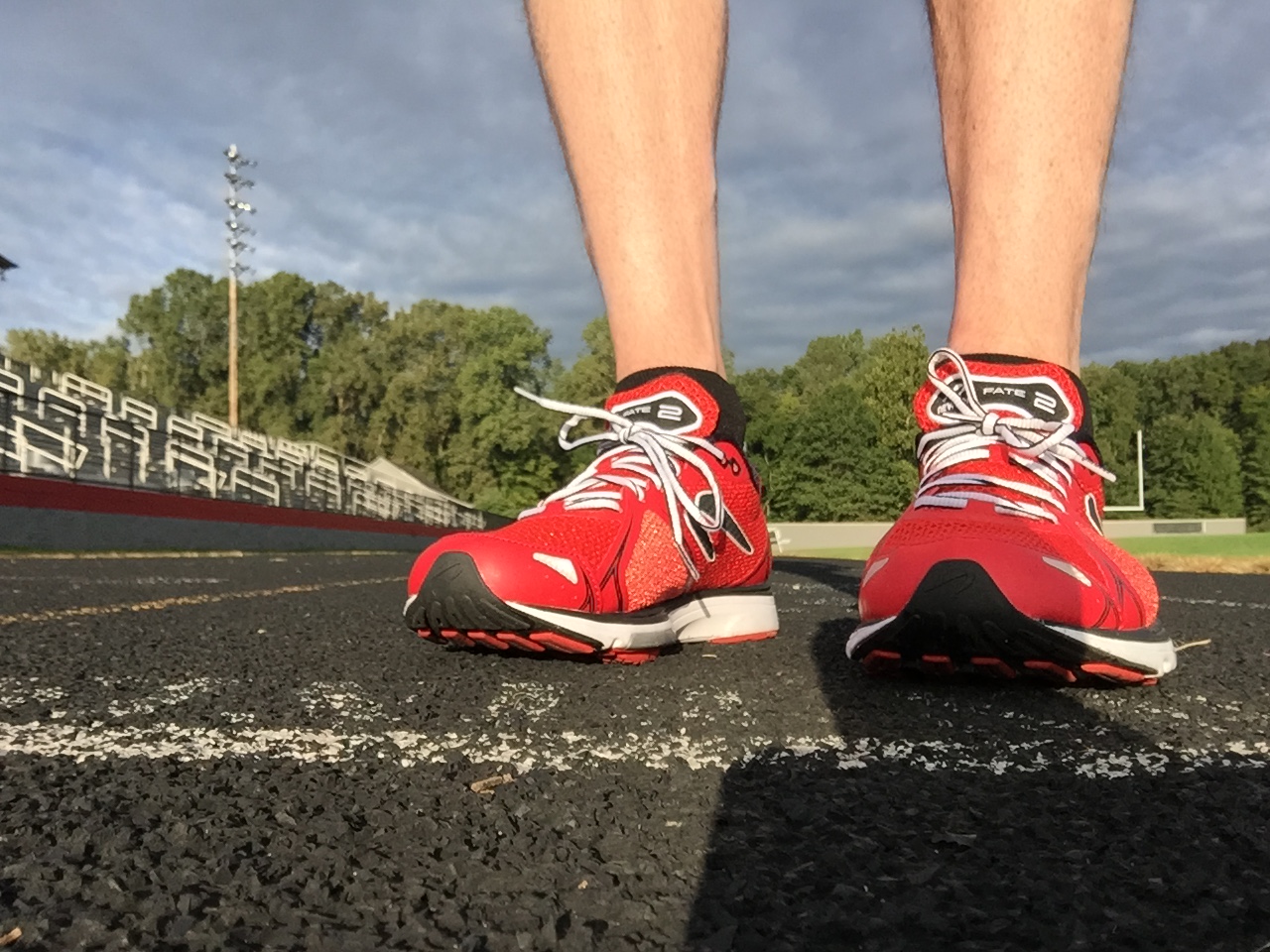
After all that, let me tell you about my new wheels – the Newton Fate 2.
I won’t get all techie on you about the fabrics, cushioning, and science behind the design because you can read about that from the aforementioned shoe nerds and run geeks online. I will tell you that these shoes are pretty cool, and they feel unlike any other shoe I’ve run in.
The Newton Fate 2 has a unique outsole that encourages mid-foot striking for optimum run efficiency. At first it feels like an extra pad under the ball of your foot (between toes & arch) that takes a bit to get used to. But once you do, I feel like it helps spring me into my next step and helps me to stay off my heels. I think these will be my new “fast shoes.”
The fit is snug yet comfortable for my size 11.5. I thought it ran a bit small compared to other brands of the same size, but I think that has more to do with the feel underfoot than anything else. I haven’t experienced any blistering or rough spots in my toes, which usually indicates a bad fit, so I’m satisfied. The toe box is roomy and flexible as well. Laces seem a wee bit short, but it’s better than being way too long.
The drop is just 4.5mm which is small compared to what I usually run, but with the Newton P.O.P 2 (Point of Power) pad and lugs at the forefoot, I think it’s easier to run in than a traditional “flat” shoe.
The Newton Fate 2 is a lightweight road runner more geared for shorter distances and racing. Although I’m sure you can have success in marathon distance with this shoe, I’ll reserve it for shorter runs. Traction is nice for paved and firm non-paved surfaces, but this shoe is not designed for aggressive trail running.
These shoes look cool. I like red shoes because they make me feel fast and they clash perfectly with everything I wear. There are reflective details on every side which is nice for early morning runs when drivers aren’t quite awake yet.
Bottom Line
I’ve tried lots of different shoes and I’ve liked most of them. I’d say that I only missed once or twice on my shoe choices over 8 years or so that I’ve been running seriously. I look for shoes described for the intended use I’m looking for, their appearance, and price. I’m not married to any particular brand and I won’t pay retail price for running shoes. Ever. I’ve had great success with Active Gear Up where I routinely pay less than $60 for my shoes retailing at $120 and up. I chose the Newton Fate 2 because they were described as lightweight road runners that encourage a mid-foot strike and they were on a killer sale and in my preferred color. Now that I’ve worn them several times I can say they are comfortable and they make me feel fast, which is a tall order. I’d go for Newton’s again and would recommend them to anyone.
I reluctantly started running in 2009 at the age of 35. I never liked running. In fact, I had managed to avoid running as much as possible my entire life. I always thought runners were crazy. Why on earth would I volunteer to torture myself with an activity that is utterly exhausting when there are so many other things I could do for exercise that are actually fun?
I’ll save the long story about how I got into running for another article, but suffice it to say that I was mentally ready for something new and challenging. I had to wrap my mind around the idea that I was going to do this running thing no matter what. Once my mind was made up, the rest was much easier.
I’ve learned a lot about running over these past 8 years. I’ve taken a great class on running form, had excellent personal training from an online program I recommend, read a ton on the subject, and practiced a lot. I’ve probably run 3,000 miles and raced in 2 marathons, a 1/2 marathon, a list of 5k’s, and many triathlons including 2 at half Ironman distance. I’m no professional by far, and many people have far greater credentials than my humble run resume, but I bet this list can still help you avoid some of my mistakes.
1. ONLY RUNNING
Fortunately, I was running to prepare for triathlon the first few years so I didn’t have much problem incorporating other forms of training besides running. And since I had great counsel and resources for cross-training at my disposal, this honestly hasn’t been a huge issue for me. However, I do know that marathon training is exhausting and the thought of cross-training on top of the running load sounds horrible. I wasn’t awesome at it for my first marathon, and I paid for it dearly. Take my advice here: run less, cross train more. You will like running more, your body will thank you, and your performance will improve.
2. NOT MOVING POST WORKOUT
It is a great temptation to plop down on the couch and relax after a hard run. I learned the hard way that the stiffness and soreness that comes with vegetating on the couch, or sitting in my office chair to work is much worse than the 5-10 minutes invested in doing a proper cool down. I’ve learned to keep the blood flowing by walking, gentle stretching, and foam rolling after a hard run. It’s really helped my recovery!
3. EATING NEW FOODS BEFORE A RUN
Definitely do not eat something new before a race. However, I believe that trying new foods before a training run is essential to dialing in your personal nutritional needs to perform your best. Sometimes that means your runs will be awful because your guts to do not agree with you, but that’s all part of learning the art of running. You must listen to your body. Take notes on what works and what doesn’t. I recommend avoiding anything really heavy before a run and I prefer real food options vs. lab created chemical concoctions labeled to be performance fuel. Unless your run is longer than an hour, you really don’t need to eat anything.
4. BEING TOO AMBITIOUS
A key ingredient to the perfect recipe for injury is being too ambitious. A rule of thumb is to avoid more than a 10% increase to your mileage or time per week in run training. The truth is that it takes time to get into run shape, so be patient with the process. If you are targeting a race event, I recommend following a training plan suited to your goals and fitness level. Not every canned training plan on the internet will work for you. I know a guy who would love to help you with your personal training plan. (wink, wink)
5. FORGETTING TO TAKE REST DAYS
Dude, you have to take rest days. Rest days are training. There is nothing macho about running every day, or doing any strenuous activity every day. It’s foolish. Overtraining will eventually catch up with you either by exhaustion, decreased performance, or injury. Settle down and consider rest day as a training day.
6. IGNORING YOUR FORM
I had no idea there was such a thing as running form. Everyone knows how to run, don’t they? Turns out that even though I played sports my whole life, I didn’t know how to run efficiently until I took the Good Form Running class. While everyone runs a bit differently, there are some key principles you should practice to help you avoid injury and improve your efficiency. Cross training to strengthen & stretch your hips, glutes, and hamstrings will also help with your form.
7. TRYING TO RACE EVERY RUN
When I first started running, I tried to PR [run a personal record] every time I stepped out the door. I learned the hard way that this is another key ingredient in the recipe for injury. I’ve since adopted a run plan with just 3 focused runs a week, and only one of them is focused on speed.
8. SKIPPING LEG (OR HIP) DAY
I had IT Band syndrome pretty bad the first few years of running because I didn’t do enough hip strengthening. If you want to make running a miserable experience, try running with constant pain in your legs/ knees. I’m pretty sure this is why many people quit running or say they can’t run. Many pains in the knees, shins, feet, etc. are from muscle weakness that can be fixed with proper strength training. Don’t skip it.
9. BELIEVING YOUR SNEAKERS ARE IMMORTAL
Runners can get emotionally tied to their favorite shoes. It happened to me. Sometimes you have to relegate them to everyday shoes, then to mowing shoes. Do yourself a favor and get new shoes more often than you need to. Then you can rotate them in your training plan so they all last longer. I’m always on the lookout for a great shoe sale (link to active.com) and have scored a couple pair at less than $40 with shipping. Like a particular shoe? Buy two pair. Remember Lieutenant Dan says, “take good care of your feet.” You can’t run anywhere with busted wheels.
10. REFUSING TO STOP
A follow up to my advice earlier about listening to your body, you need to learn the difference between injury pain and just tired pain. If you have an injury pain, running through it will only make it worse. Yeah, your training plan may derail for a while, but you’ll be back at it much faster if you rest & recover instead of worsening your injury with overuse. Just recently, I forced myself to stop in the middle of an “important” sprint set because I tweaked my hamstring. I knew that a pulled hammy would mean weeks of rest and it would keep me from racing in a couple weeks. Missing a couple workouts to let it rest turned out to be way better than “pushing through the pain.”
11. NOT FUELING CAREFULLY
If you plan to run longer than an 60-90 minutes at a time, you will need to take some kind of fuel during the run. Knowing what works takes practice. See advice in #3. In my first marathon, I made the mistake of taking all the goodies offered at the aid stations instead of sticking to what I used throughout training. The result was a bonk and a very upset stomach. Yuck.
12. BLINDLY FOLLOWING TRENDS
Another ingredient to the recipe for injury is doing what everyone else seems to be doing. Trust me, not EVERYONE is following the latest trends. (think toe-shoes or minimalist shoes for example) Many have learned the hard way that the latest thing isn’t necessarily the best for you. Sometimes the saying, “If it ain’t broke, then don’t try to fix it,” is the best advice.
13. NOT HYDRATING PROPERLY
I just took a big drink of water, lol. Just like food/ fuel in running, hydrating takes practice. If you are well hydrated before you start, you probably won’t need anything if your run is less than 60 minutes. For longer runs, you need to carry water or strategically place water bottles on your course. Being dehydrated in your run can be dangerous to your health. A rule of thumb I follow is to have about 1 bottle of fluid (24 oz) per hour. There are tons of options for hydrating drinks during long runs. My advice is to try different ones to see what works best for you. And know that the most popular brands advertised as electrolyte drinks are filled with chemical additives, artificial sweeteners, colors, flavors, and lots of sugar, which are not good for you. I prefer all natural and “clean” foods and supplements. Generation UCAN and Performance Hydrate are my favorite for during running. It’s also really important to drink a lot when you are done. I follow up a long run workout with a scoop of Performance Recover in water to help my muscles repair more quickly from the work.
14. NOT FAMILIARIZING YOURSELF WITH THE ROUTE
This might be way too obvious, but I’ll say it anyway. Getting lost and being far from home or your car is not cool. Take the time to sort out your route before you start. And even though an “out & back” route isn’t as cool as a loop, the chances of getting lost are greatly reduced.
15. NOT VALUING RECOVERY RUNS
This one goes along with #7. Recovery runs should be done at an easy, moderate pace. My biggest mistake in my early years of running was doing too many fast workouts and letting individual runs turn into mini races themselves. Now I make sure that one of my 3 focused run workouts each week is at easy, moderate pace.
16. FORGETTING ANTI-CHAFE CREAM
Body Glide is your friend. So is proper running gear. Please do not wear a cotton shirt for a long sweaty run. Bloody nipples are not fun. After you experience chafing once, you will remember where to use the cream.
17. OVERLOOKING SAFETY MEASURES
If you must run in the dark, please remember to wear reflective gear at minimum. A head lamp comes in handy too if you are really into the night run thing. I carry my phone when I’m going away from my neighborhood route. I also like to wear my Road ID so if I get run over hopefully someone will still know who I am and call my wife.
So there you have it. 17 mistakes you can avoid because you took the time to read this article. Happy running!
Just like healthy and sustainable weight loss there’s no secret formula when it comes to running faster or longer. However, there are a handful of simple things you can do to improve your running — and they all add up. Luckily, it’s less complicated than you think.
While there are myriad ways to tweak your running for improvement, most of them fit into five categories: supplementary strength work, running volume, consistency, variation and non-running activities. While there is overlap among each of these categories, it’s best to address all five in some capacity to get the most out of your training.
Here are five common mishaps that can keep you from realizing your running potential:
1. YOU’RE NOT SUPPLEMENTING YOUR RUNNING
Runners are a frequently injured bunch. Some studies show injury rates for runners as high as 60–65% annually. Running consistently is more than half the battle, but to be consistent, you need to prevent injuries by supplementing running with strength and core work.
Running is a demanding and repetitive sport, and it can be hard on your body if you don’t take the time to strengthen the muscles that support you. As you progress and start to get faster, there’s a tendency for your aerobic fitness to outpace your structural fitness. That means you’re heart and lungs may be ready for more work than your strength can handle, which can result in injury.
Since many of us are largely sedentary outside of our workouts, our bodies aren’t always prepared to handle the stress of running. Fortunately, even a small amount of regular strength training improves our structural fitness and allows our bones, ligaments, tendons and muscles to support us and stay healthy while running.
Simple Solution: Perform 5 minutes of active warm up before each run.
2. YOU’RE NOT RUNNING ENOUGH
Runners who tend to get injured the most are the ones who stop and start often, or take frequent weeks or even months off. They are constantly in a cycle of trying to rebuild, which puts them at a greater risk for injury. If there is any magic bullet to running, it’s that running consistently will help you improve.
Simple Solution: Stay consistent with how many days you run each week, even when you’re not training for something specific. It’s all too easy to get off track when you start skipping runs on a regular basis.
3. YOUR TRAINING IS INCONSISTENT
Inconsistency will thwart even the best intentions and can be your worst enemy when it comes to improving your running. Consistency, on the other hand, is your best friend. Running is cumulative over months and years of training, and consistency is what allows you to weave together a sustainable running career.
Inconsistency can crop up in several areas — from mileage and number of runs per week to speed workouts. Sometimes it’s due to an unavoidable overload in other areas of your life, but a lot of the time it’s simply a result of losing focus or motivation, or not following a quality training plan.
Stay consistent by focusing on the little things that motivate you to get out on a regular basis, whether it’s a goal race, fundraising and training for a cause, catching up with a friend or just enjoying the energy that comes from starting your day with a run.
Simple Solution: Find a plan that works for you, and stick with it! A coach will provide the most personalized schedules, but there are plenty of great resources and training plans available to keep you on track.
4. YOU NEED MORE VARIATION
First consistency, now variation? Yes, you need them both. Although this may sound contradictory, the key is knowing when to apply each principle. Here are some areas of running where you want variation:
Types of runs: Easy, moderate and hard running all have their place. If you want to keep improving, you don’t want to run the same pace and distance every day. My marathon training plan incorporated each type in just three focused runs per week.
Running surface: Many of us spend a lot of time on the road, but the constant pounding can be tough on your body. Vary the surface you run on each week, and include trails and softer surfaces. Your feet and legs will thank you.
Shoes: It’s ideal to rotate among 2–3 types of shoes each week. This is yet another way to minimize the repetitive nature of running. You may want to try a lighter, more minimal shoe for speed sessions and a more supportive shoe for longer or recovery runs.
Simple Solution: Make each run have a purpose. When your run is supposed to be easy, don’t be tempted to push hard. And when you have a key workout, give it your all. Avoid constantly staying in that “too-hard-to-be-easy-but-too-easy-to-be-hard” zone that provides minimal benefit.
5. THE REST OF YOUR LIFE IS HOLDING YOU BACK
The life of an elite runner is set up to provide the greatest possibility for improvement and success. They often run twice daily, get 8-plus hours of sleep along with a midday nap, have regular massages and bodywork — and spend hours on core and strength sessions in addition to their running. But that schedule is impossible for 99.9% of us.
We can’t replicate their schedules, but we can certainly incorporate some of their habits into our own training. Here are several things that may be affecting your ability to improve:
Get enough sleep: This is your body’s prime time for repair and recovery. If you’re training hard, you aren’t going to recover well if you don’t get enough rest. Sometimes I’ll take some Beachbody Performance Recharge before bed to help me sleep and repair my sore muscles. It really helps!
Pay attention to your nutrition: Simply focus on eating more real, whole foods. If you put your energy toward adding more fruits and vegetables into your diet and minimizing sugar and processed foods, you’ll have a fantastic “whole-food” diet. This becomes increasingly important as your mileage builds. You know my go-to resource is 90/10 Nutrition. Learn how to clean up your diet without starving, counting calories or points, or taking some chemical concoction.
Limit life stress: Build a schedule that works with your life. Try to plan your training and races in a way that works with your current schedule and reduces stress. When major life events happen, let running be an outlet rather than an added stress. For me, running can be a “mental health break” as well as a great workout.
Keep up with body maintenance: Maybe you can’t get a massage every week like the elites do, but you can certainly book one on occasion and keep up with self-maintenance, likefoam rolling, at home.
Simple Solution: Don’t try to change too many things at once. Make simple, sustainable changes, like getting to bed 15 minutes earlier each week or adding more vegetables to one meal each day. It’s all about Baby Steps!
Don’t let any of these reasons keep you from running your best. If you’re looking to improve, addressing these options is a great place to start.
Special thanks to Jason Fitzgerald and the mapmyrun blog for doing the heavy lifting on this article.







 Team Quadzilla
