Fitness

Performance Enhancers You Need Now

People everywhere are looking for an edge. We’ve heard stories of the illegal performance enhancing drugs athletes have taken to get ahead of their competition. Doping scandals in cycling, steroids in baseball and football, and all kinds of crazy stuff in bodybuilding are what most of us think about when we hear the term “performance enhancers.”

You don’t have to be an elite athlete to be tempted by performance enhancement though. Have you seen the ads for magic potions you can take to boost your energy, stay alert longer, improve mental clarity? These products are marketed to you and me – regular people who feel exhausted and just want to keep up with the demands on our time and energy, let alone excel at our roles of spouse, parent, worker, weekend warrior, etc.

infuses-red-bull-with-5-hour-energy

If you are like me, you aren’t likely going for illegal substances to keep sharp, but maybe you’ve been tempted to pop a pill or take some elixir to gain the edge you desire.

Well, I have some good news weary friend! We don’t need illegal substances, controlled substances, or so called energy potions to help us through our busy days. We can be our best by incorporating a few simple disciplines into our daily life.

all-natural-y13w7x

Sleep

We need to rest. 7-8 hours of sleep per night is recommended. You are laughing because that hasn’t happened for you in a long time. But why not? I challenge you to review your schedule and see where you can change your routine to get the rest you need. Chances are, you don’t need to watch that late game, movie, or TV drama. If you are just vegging in the evenings, I suggest cutting that short and going to bed. I wrote earlier about HOW TO SLEEP, and if you are looking for some rest for your weary soul, I covered that topic HERE.  Bottom line is that if you want to be sharp, you need to rest. Schedule it in your day like any other important appointment.

Water

I’m willing to bet you don’t drink enough water. Most of us don’t. There is a simple way to know if you are well hydrated. Look at the color of your urine. The more clear it is, the more hydrated you are. Being hydrated wards off common headaches, grumpiness, and a long list of physical ailments that keep you from being your best. Proper hydration = better performance.

Exercise

“I don’t have time to exercise!” Baloney. You don’t have time to SKIP exercise. Regular vigorous exercise is so good for you. It’s a natural mood booster, gives mental alertness & clarity, and actually energizes you for the day. Morning or mid-day exercises will help you power through your work day like nothing else. Besides, what good can you be in your most important roles at home and work if your body is a wreck and you are sick all the time? Take care of your body, and it will take care of you – and enhance your performance.

Balanced Diet

“Ugh. You had to mention food.” Yep. Food is fuel and your body is a finely tuned MACHINE. The fastest way to get physical results in your shape is through proper nutrition. Contrary to popular belief, you don’t need to follow the latest fad diet or starve yourself or spend a fortune on fancy produce to eat healthy. What you need is to eat reasonable portion sizes, more veggies, less cake and beer, and you will be shocked at how much better you feel. When you feel great, performance is enhanced – naturally.

BB Performance

OK, so there is this one thing. Sometimes we could use a quality supplement to our healthy lifestyle. I found the Beachbody Performance line to be just that. With real food all natural ingredients, these supplements taste great and help my body perform optimally.

IMG_2033

Personal Development/ Journaling

You’ve got to feed your mind and soul as well as your body. Taking time daily to read and reflect on something positive and encouraging (hmmm, the Team Quadzilla blog…) will go a long way to keeping you sharp and performing your best. The inputs to our mind dramatically impact our mood and attitude.  I find great encouragement in journaling. It doesn’t sound very manly, but let me tell you it is super healthy. If you want to leave a positive legacy for the next generation, I encourage you to journal your thoughts, prayers, fears, dreams, and happenings in your life. Those who come behind you might be encouraged by your writing. Journaling also helps to clear your head, reflect, and focus your mind for the day. It’s an exercise worth doing daily.

So there you have it. Nothing earth shattering here, but that’s kinda the point. Healthy living is not supposed to be complicated. We still need to actually DO these things though. Start with one and move on from there. You want to be your best and many others are counting on you as well. Maybe these simple reminders will inspire you to make a change today.

Fitness

10 Reasons Why You Hate Working Out

Why You Don’t Like Working Out, And How to Improve Exercise Motivation

Why you hate it: It’s boring.

Solution: For some people, there’s nothing worse than running. Others hate swimming. And still others would rather get a root canal than lift weights at the gym. That’s why it’s important to try a variety of exercise styles to find what most appeals to you. There are tons of different types of workouts that appeal to all types of people. My guess is that if you think exercise is boring, you just haven’t found something you like. Try something new.

I can help you find interesting ways to get moving, or you can head to Beachbody On Demand for a selection of more than 40 different workout programs for all fitness levels and cover everything from weightlifting to yoga. Check out this guide to get an overview of the most popular options.

Why you hate it: It’s not fun to workout alone.

Solution: A good workout buddy can boost your enjoyment, and studies show that it can even encourage you to exercise more often. When it comes to working out, being accountable to another person can also go a long way towards keeping you on track with your schedule.

Working out in a group can multiply the benefits — especially when it comes to exercise enjoyment. Some have found great success with a group at the gym or in virtual/ online groups.  Conversely, working out alone CAN be fun and very rewarding if you have a personally compelling reason WHY you are working out. When your mission is greater than your fears & excuses, you will mysteriously find joy in the process – even when you are doing it alone.

IMG_0036

Why you hate it: It’s exhausting.

Solution: When you get home from a long day at work, all you want to do is plant your butt on the couch; trying to summon enough energy to exercise is the last thing on your mind. But research shows that physical activity can increase energy levels rather than sap them. Working out could be just what you need to have a productive end to your day.

But if you just can’t pick yourself up in the evening, pick a time of day to work out when you’re typically more energized, and when you can work out consistently. That last part is key. As the saying goes “the best time to work out is the time when you will work out.”

Why you hate it: You’re afraid you’re going to fail.

Solution: Sometimes it feels easier to avoid a task altogether than to risk falling short of your goal. If you never start trying to lose weight, then you can’t fail at it, right?

This is why Baby Steps are key: They help you work towards something you can actually achieve. “It’s important to set small, reasonable goals for yourself,” Dr. Leo Marvin says. Acknowledging your success can be a huge step forward in making the workout plan more enjoyable. When you hit a goal, celebrate it and set the next baby step.

Truthfully, the only way to fail on your healthy living journey is to never start, or to give up. This is a journey – filled with ups and downs, progress and setbacks. Embrace the journey and press on. Your future self will thank you for conquering your fear.

Why you hate it: You don’t like getting sweaty.

Solution: Unfortunately, in order to lose weight or gain strength, you’ll need to put in some hard work and get sweaty at some point. To avoid having to repeat your ‘get ready for work routine’, time your intense workouts to the beginning or end of your day.

Fortunately, you don’t have to subscribe to a gut-busting, sweat-soaked workout every single day. There are low-impact and low-intensity exercises that can give you a decent calorie burn without sweating buckets. Try activities like yoga or walking. Research suggests that you can gain major health benefits from a simple 30-minute walking routine. It’s enough to get your heart rate up, but won’t leave you soaked and smelly.

Why you hate it: It takes up too much time.

Solution: Whether you have a demanding job, no childcare, or both, it can be a challenge to find time to exercise. This is the most common excuse I hear for why people don’t exercise. To get over this hurdle, start small, and make exercise a non-negotiable must-do. Schedule it like you would a recurring business meeting. Start treating exercise like a key part of your day instead of a perpetual afterthought.

Break up your workout into short intervals throughout the day if you aren’t able to find a time to get everything done at once. I shared some excellent body weight workouts you can do anywhere anytime that really work. Try “habit stacking.” Simply add a few minutes of exercise on top of something else you already do every day, like doing some push-ups after you brush your teeth. You don’t have to work out for very long to notice a benefit (research shows that even a few minutes of intense exercise per week can improve cardiovascular fitness), but you do have to be consistent.

IMG_0453

Why you hate it: You can’t afford or don’t want to pay for a gym membership

Solution: Access to workout facilities and equipment can play a major role in sticking with a workout routine. So why add extra obstacles like a gym membership or tons of gear into the mix when they’re not necessary? Angie and I exercise in our living room with minimal equipment. Though we have different expressions after our workouts, it sure beats going to the gym! With Beachbody On Demand‘s extensive exercise library, which includes more than 600 fat-blasting workouts that can be done in a six foot-by-six foot area — we never get bored, and don’t have to leave home. Not only does working out at home save you the money of a gym membership, but it also lets you exercise on your own time.

Why you hate it: It’s embarrassing to work out in front of other people.

Solution: Exercise is supposed to relieve stress, not contribute to it. If you make yourself work out in an environment where you feel judged, it’s likely you won’t stick with it. This is a big reason why at-home workouts are so appealing. Being able to exercise in the privacy of your own living room removes the fear of being judged by others. It also allows you to slow down and learn new exercises at your own pace, instead of feeling pressured to do it right the first time.

Why you hate it: You’re really out of shape.

Solution: The first few days or weeks of a new exercise program are often the hardest. Even when you do muster the energy to work out, new moves often leave you feeling tired and sore in places you didn’t even know existed. To avoid this, take steps to prevent muscle soreness so you don’t get discouraged. Start slowly, and gradually increase your effort and intensity based on how you feel after each successive workout.

What you eat after working out can also optimize your recovery and help prevent soreness. Beachbody Performance Recover is made with 20 grams of protein to aid muscle repair and growth, and it contains pomegranate extract, which has been shown to reduce muscle soreness.

Additionally, listen to your body and schedule rest and recovery days when needed. Getting enough sleep, stretching, and eating well is extremely important. Try not to work the same muscle groups really hard on consecutive days.

Why you hate it: It’s all just too overwhelming.

Solution: The sheer volume of fitness advice in the world can be intimidating. That’s why it’s vital to not overcomplicate the process of getting started. Keep it simple: Think about what sounds like fun and really go for it. Just DO something. Yoda says, “Do or don’t do, there is no try.” Exercising is still work. Results take time and effort, so don’t give up when it gets difficult. Make the commitment to yourself to get on the healthy living train and stay there. One baby step at a time. Be stronger than your excuses. You can do this!

Special thanks to Mackenzie Lobby Havey and the Team Beachbody blog for doing the heavy lifting on this article!

Fitness

Take Care of Your Hips – 9 Best Hip Stretches

If you are a Desk Jockey like me, this article is for you. Consider all the time you spend sitting at a desk or in your La-Z-Boy. For many of us, there are WAY too many of our waking hours spent drafting spreadsheets, attending meetings, posting on social media, watching Seinfeld re-runs, etc. That’s a lot of time for your hip joints to be stuck in a single position.

That’s a problem. “Elongated periods of sitting sends messages to certain muscles to stay turned on which keeps other muscles turned off,” says Beachbody fitness expert Cody Braun. “This creates an imbalance, which can immobilize your hips.” Your hips are built to move in almost any direction, explains Braun, and when they’re stiff, they don’t just make exercise more difficult; they also make you more prone to pain in surrounding joints — including the oft-troublesome lower back.

If your hip joints could use some TLC, help has arrived. All you need to do is spend a moment or two before and after your workouts or, heck, while watching TV — on a time-honored fitness activity that few of us do enough of: stretching. Below, I’ll show you some of the best hip stretches to improve flexibility and mobility, hopefully making up for all that time on your bum.

Why Hip Mobility Is Important

Quick physiology lesson: when a joint becomes stiff and immobile, the joint above and below it moves to compensate. So if you can’t move your hips, you’ll move your lower back instead.

Know anyone with lower back pain?

Oh, that’s right the overwhelming majority of Americans has lower back pain. If that includes you, you may benefit from making some or all of the hip stretches below part of your regular routine.

But mobile hip joints don’t just relieve pain. They’re also essential for walking, hiking, running, jumping, dancing, playing sports, and pursuing virtually any fitness goal safely and effectively. Want to develop stronger, more muscular legs? Hip mobility allows you to lunge and squat more deeply so you can reach your muscles’ potential. Want to avoid injury? Hip mobility improves range of motion so you can perform exercises more safely.

Anatomy of the Hips

The pelvis, that sturdy, bony structure that houses your hip joints, is the Grand Central Station of the body: dozens of different muscles, nerves, and tendons attach to and pass through it. The main ones you’ll focus on in your hip stretches are:

hip-stretches-anatomy-350

Hip flexors

These muscles extend roughly from your spine to your thighs. Their main job is to pull your thighs toward your chest. When they’re tight, they can pull the front of your pelvis downward, causing strain and pain in your lower back.

Hamstrings

This muscle group, including the biceps femoris muscle, runs along the backs of your thighs from your hips to your knees. Your hams oppose your quadriceps, bending your knee and helping to extend (straighten) your hip joints behind you.

Adductors

Located on the insides of your thighs, these muscles squeeze your legs together, and can cause tightness and limitation when you step laterally (sideways).

Glutes

The butt muscles work along with the hamstrings to extend, or straighten, your hips, and, with the aid of the abductors on the outsides of your hips, raise your legs out to the sides.

Stretch these four main areas to help increase mobility, and you’ll be good to go.

2 Main Types of Stretching and When to Use Them

The 9 hip stretches below, all culled from the extensive library of full-body workout programs available at Beachbody on Demand, offer two different stretching techniques: dynamic and static stretches, which you should use at different times.

Dynamic stretching

These are large, full-range movements of one or more joints at once, often performed standing and sometimes while walking or jogging. They resemble old-school movements you might have done in calisthenics or gym class: arm swings, leg swings, high-knee walks. You usually count off reps, rather than time, on dynamic stretches, which work best as a warm-up activity before a workout, or any time you need a pick-me-up boost throughout the day.

Static stretching

These movements are slower and mellower; they’re the reach-and-hold stretches you might see in a basic yoga or stretching class. Forward bends, knees-wide butterfly stretches, the pigeon, or the figure 4 pose in yoga are classic examples.

Often you’ll perform static stretches seated or lying down, and focus on breathing slowly and deeply to facilitate relaxation sometimes for several minutes at a time. Static stretches can be very effective at loosening you up, but they also inhibit performance in the stretched muscles for a short time afterwards. So they’re best reserved for after a workout, or as an any-time stress reliever just not right before a workout involving the muscles you’re stretching.

9 of the Best Pre- and Post-Workout Hip Stretches

Together with a healthy diet and a great workout program, the following hip stretches will leave you feeling and looking your best.

Seated Leg Cradle

leg cradle

Type of Stretch: Static

Benefits: Lengthens and relieves tension in the glutes, adductors, and hamstrings.

Appears in: Yoga Studio – Hip Opening With Faith

• Sit on the floor with both legs extended straight in front of you, feet flexed.

• Keeping your back straight, draw your right knee toward your chest, and try one or more of the following variations:

  1. Holding your right knee in your right hand, grab your right ankle with your left hand and draw it toward your chest as far as you can.
  2. Draw your right ankle toward your chest and rest your lower leg inside the creases of your elbows, bending them to draw your leg as close as you can to your chest.
  3. Draw your right ankle toward your chest and wrap your arms around the lower leg, interlacing your fingers with your knee inside the crease of your right elbow and your foot inside the crook of your left. Hug your lower leg toward your chest as far as you can.

• Keeping your back flat, your chest up, and both feet flexed, rock slightly left and right.

• Hold for 30 seconds, then repeat on the other side.

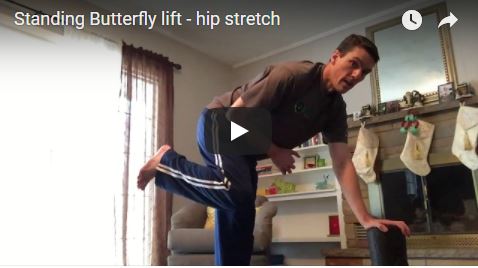
Standing Butterfly Lift

standing butterfly

Type of stretch: Dynamic

Benefits: Activates the glutes while improving mobility in the hip capsule (the ligament that attaches the leg to the pelvis) and adductors.

Appears in: Yoga Studio – Get Well Rounded With Elise

• Stand with your feet shoulder-width apart about 18 inches behind two yoga blocks positioned on the floor at the tallest height.

• Hinge forward at your hips and place your hands on the blocks. (If that’s too difficult, use a taller surface like a chair instead.)

• Bend your right knee, pulling your heel towards your right glute, and keep it there throughout the set. This is your starting position.

• Keeping your back flat and standing leg straight, lift your right knee as far out to your right side as you can.

• Reverse the move, lowering your right knee until it’s close to your left.

• Repeat for 10-12 controlled repetitions, then repeat on your other side.

Frog Alternate Legs
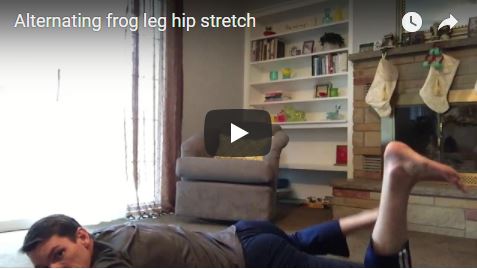
frog leg

Type of stretch: Dynamic

Benefits: Stretches the adductors and improves mobility in the hip capsule.

Appears in: Shift Shop  Shift Mobility

 Lie face down, bend your knees about 90 degrees, and spread them as wide as you can. Fold your hands under your forehead to relax your upper body.

• Keeping your knees bent, slowly roll your right thigh inward, lowering your right foot toward the floor.

• Try to tap your right foot on the floor, and reverse the move, repeating on your other side.

• Continue slowly alternating sides for 30 seconds.

Butterfly
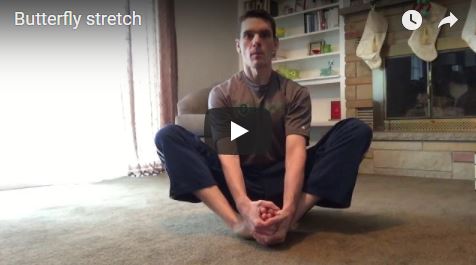
butterfly

Type of stretch: Static

Benefits: Lengthens the adductors and reduces tension along the entire spine and back of the neck.

Appears in: 21 Day Fix  Yoga

• Sit on the floor upright with your legs bent, the soles of your feet together, and your knees spread wide.

• Keeping your knees spread as wide as possible, take hold of your feet and slowly pull your forehead towards the floor.

• Hold this stretched position for 30-60 seconds.

Scorpion

scorpion

Type of stretch: Dynamic

Benefits: Stretches the quads and hip flexors, and activates the glutes.

Appears in: P90X3  Dynamix

• Lie on your stomach, with your legs straight, and arms extended out to the sides, forming a “T.” Your palms should face down.

• Keeping your left leg straight, lift your right leg off the floor, bend your right knee, and cross your right foot behind your left, continuing up toward your left hand.

• Try to tap your left hand with your right foot, and return to the starting position.

• Continue for 30 seconds, and repeat on your other side.

Runners Lunge
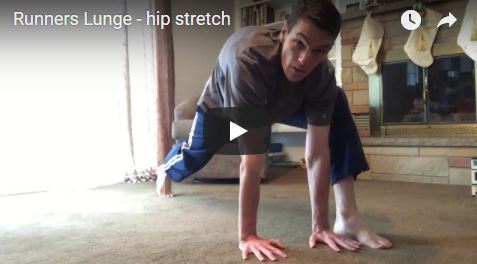
runners lunge

Type of stretch: Static or dynamic, depending on how long you hold the position.

Benefits: Stretches the adductors and glutes.

Appears in: 21 Day Fix Extreme  Yoga Fix Extreme

• Assume a pushup position: hands and balls of your feet on the floor, both shoulder-width apart, and your body straight from head to heels.

• Step your right foot to a point just outside your right hand. (Your right knee should be near your right shoulder.) If possible, lower your elbows to the floor.

• Hold for 15 seconds, and reverse the move to return to the starting position

• Repeat the entire sequence on your other side.

Sumo Reach
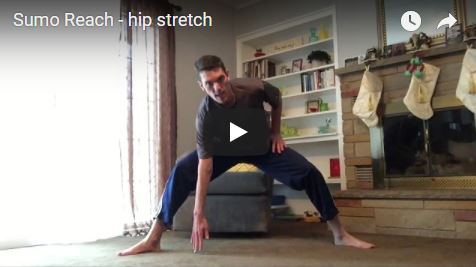
sumo reach

Type of stretch: Dynamic/static

Benefits: Strengthens the glutes and shoulders, stretches the adductors, opens the hip joints, and rib cage.

Appears in: Insanity  Max Recovery

• Assume a wide stance, turning both feet out about 45 degrees.

• Keeping your torso upright, and your core engaged, bend your knees and lower your trunk as you extend both arms straight out to the sides, palms down, forming a “T.”

• Perform three pulses downward, sinking more deeply into this wide-stance (“sumo”) squat each time.

• Keeping your back long and your arms straight, bend your torso to the left as far as you can, and try to place your left palm on the floor near the inside of your left foot.

• Look up at your right palm and hold the position for a 5- to 10-count.

• Brace your core to return to the starting position, and perform the entire sequence on your other side.

Groiner

groiner

Type of stretch: Dynamic

Benefits: Stretches the glutes, adductors, and hip flexors.

Appears in: P90X3  Dynamix

• Assume a pushup position: hands and balls of your feet on the floor, both shoulder-width apart, and your body straight from head to heels.

• Step your right foot to a point just outside your right hand.

• Sink into the move for a one-count, lowering your hips as far as possible.

• Return your foot to the starting position.

• Continue for 30 seconds, then repeat on the other side.

Too tough? Perform the move with your hands elevated on yoga blocks.

World’s Greatest Stretch
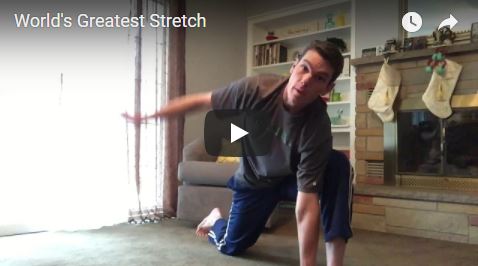
worlds greatest

Type of stretch: Static

Benefits: Lengthens the hip flexors, adductors, chest, and rib cage.

Appears in: Clean Week: Mobility

• Start in a deep lunge with your right foot forward, your left knee and top of your left foot on the floor behind you, and your palms about hip distance apart on the floor inside your right foot.

• Keeping your back flat and both arms straight, lift your right hand up toward the ceiling as high as you can, twisting your torso into your right knee.

• Hold for 10 seconds, then return your right hand to the floor.

• Maintaining the same position in your lower body, lift your left arm up towards the ceiling in the same manner.

• Hold for 10 seconds, then slowly return your left hand to the floor.

• Switch sides, and repeat the sequence.

Thanks to Andy Heffernan and the Beachbody Blog for doing the heavy lifting on this article.

Fitness

12 Tips to Help You Stick With Exercise

IMG_0058_Moment(2)

Exercise by definition is work. And it’s hard to put in the work to get results. It’s easy to talk yourself out of exercising. Even when you have the best intentions to work out, excuses are so easy to find — “I’m too tired,” or “I’m busy,” or “The weather is bad.”

The right attitude and a few tricks can keep your fitness routine on track. Use these tips to stay in the game:

1. Do it for yourself. Studies show that people who are “externally motivated” — that is, they hit the gym just to look good at the class reunion — don’t stick with it. Those who are “internally motivated” — meaning they exercise because they love it — are the ones who stay in it for the long run. Check out this video from the Quadzilla YouTube archive to help “find your WHY” to make exercise part of your lifestyle.

2. Take baby steps. You would never try to run 10 miles on day one, right? When you do too much too soon, you’ll end up sore, injured, and discouraged. Take it easy as you get started. Maybe you only run a quarter mile your first week. When that becomes easy, you can make it more challenging. Having a plan to follow will expedite your progress without killing yourself. Baby Steps really works!

3. Hang tough. No one has perfect form the first day of strength training. Every workout takes practice. You’ll get the hang of it if you keep making an effort. And if you use the best home workout videos in the universe, there is always a modifier to help you ease into the moves.

4. Mix it up. Do different types of workouts to keep things interesting and to exercise different muscle groups. I can testify that running 5k’s works your legs and lungs differently than when playing basketball. Mix up your cardio to optimize your fitness gains. Also, switch up your weight lifting routine with some killer body weight exercises. You don’t have to reinvent your entire routine every week, but you do want to shift it around a little.

5. Don’t be your own drill sergeant. Half of all people who start a new exercise program ditch it within the first year. It often happens because they can’t keep up the boot-camp pace they’ve forced on themselves. It’s better to work within your limits, and gradually get stronger.

6. Bring a friend. When your inner demons order you to hit the couch instead of the treadmill, a workout partner can steer you back in the right direction. It’s easier to bail out on the gym than on the friend who waits for you there. Studies show you’ll also work out longer when you have a pal along. I like to exercise with my wife and son. We hold each other accountable and it’s something fun to do together.

7. Show the clock who’s boss. Health experts say you should aim for at least 150 minutes of exercise a week (30 minutes a day, five times a week, for example), plus weight training at least twice a week. Can’t find room in your crazy schedule? Take a closer look. If you work too late to get to a gym, keep a set of weights at home. If you can’t do 30 minutes at once, break exercise sessions up into 10- or 15-minute bursts. Trust me on this, you have more time than you think. If exercise is important to you, you will make time for it.

8. Get used to it. Your workout should be just as much a habit as brushing your teeth or eating breakfast. When it’s part of your routine, you won’t even have to think about it. In a few months, fitness can be a regular feature in your day.

9. Live in the present. So what if you missed a week of workouts and polished off a pint of ice cream over the weekend? Leave the guilt in the past. You have a chance to get back into your routine today.

10. Keep it real. You’re not going to skim off 30 pounds in a week. Aim for something that’s realistic as a first step. For instance, increase your workout schedule from 2 to 3 days a week, or exercise for 15 more minutes each time. Baby steps.

11. Track it. Keep a fitness journal or use an app to record your progress — for example, how much you run, walk, or lift and the calories you burn. Progress photos are a great way to measure your progress and remind you where you came from. A good training plan/ calendar will help with this too. Ask me about a plan to suit your needs!

12. Celebrate! It takes weeks to see real changes. Reward yourself with new gear or a sensible treat when you reach progress milestones. Share your results with others, so they can celebrate with you and encourage you to keep up the good work.

SOURCES:Acevedo E. Psychobiology of Physical Activity, Human Kinetics, 2006.CDC: “How much physical activity do adults need?”Ryan, R. International Journal of Sport Psychology, 1997.Matsumoto, H. International Journal of Sport and Health Science, 2004.Dunton, G. Medicine & Science in Sports & Exercise, September 2009.U.S. Department of Agriculture.

Fitness

How To Sleep

sleep1

We spend about 1/3 of our life asleep. So why are many of us still so tired?

People are more exhausted today than ever before. Our exhaustion has spawned an entire field of science to study sleep. Believe it or not, you can even hire a sleep coach! Sleep is now a $7 Billion a year industry.

I’m no sleep coach for hire, but I’ve done some research and learned a few things from my own experience that help me to sleep well. Not surprisingly, I learned that we are our own worst enemy when it comes to sleeping well. We are actually doing it all wrong. That’s funny. We can’t even sleep right! Maybe some of the following sleep tips can help you get that elusive restful sleep you desire. Because we should all be good at sleeping!

Pillow(s) – First of all, how old is your pillow? If it is more than a couple years old, you really should replace it. Old pillows are disgusting. I won’t tell you which pillow to buy, but you should get one to match your natural sleep position.

Mattress – Remember, you spend 1/3 of your life on the mattress so you should be comfortable. Good mattresses can be expensive, but they are a worthwhile investment. Plan for a new mattress every 7-10 years despite what the manufacturer says about their durability.

Pajamas – There is some interesting research on this one. Science says that your body goes thru some amazing regenerative processes in sleep. To optimize your comfort, Choose pajama fabrics carefully. For a female perspective, here’s how to know if your bedtime clothing choices are truly helping your body or actually causing one big nightmare. The bottom line is ultimately your personal comfort. Wear whatever makes you feel the most relaxed. If you have trouble sleeping, changing what you normally wear might help.

Keep it coolRoom temperature is an important factor. Various sources suggest keeping the temp between 60-67°F at night to optimize sleep. So save some money on your winter utility bill and turn down the heat overnight.

Darker the better – Your bedroom needs to be dark to optimize sleep. Use blackout shades, dark curtains, blinds, etc. as necessary to ensure your room stays dark while you sleep.

Eyes off the screen – Want to really sabotage your sleep? Keep right on with the TV watching and trolling social media on your electronic devices right before bed. The blue light messes up your sleep sensors. So shut it down 30-60 minutes before bed. Pick up a real book instead. Maybe use this time to talk with your spouse. Don’t get into heavy topics though. Keep it light.

Snack Time – This was a big one for me since I have acid reflux issues. Laying horizontal with a full belly is recipe for lousy sleep. While some argue late night snacks lead to weight gain, it is not always true. It depends what you eat, portion size, etc. For me,  cutting off eating & drinking anything about 3 hours before bed works well. So if you have stomach issues at night, or you are trying anything to improve sleep, give this tip a try.

Add some noise – If you find yourself being awakened in the night by outside noises (ugh, blasted train!), I recommend enlisting the help of a fan or some other white noise maker that can run all night. There are even free phone apps with a variety of sounds to suit you. I use the app when I travel, otherwise we have a fan at home that MUST be on to drown out the train.

ExerciseA good workout can help you get great sleep. Your body craves the work and rewards you with good sleep. So get your sweat on for 30 mins a day to improve your fitness and help you sleep.

Stay on schedule – Our bodies love routine. Much like young children, adults function best when there is some routine. So get to bed at the same time every night to optimize your sleep quality. Of course that means you should get up at the same time every day as well. Yep, that includes weekends.

So there you have it. My ten tips to help you sleep better. Surely there are many other tips to great sleep, so comment below to share what works for you.