Privacy Policy

Family

You’re Different and That’s Good!

you-are-different-and-that-is-good!

Nevertheless, each individual among you also is to love his own wife even as himself, and the wife must see to it that she respects her husband. —Ephesians 5:33

In Men are Like Waffles–Women are Like Spaghetti, Bill and Pam Farrell describe the mind of men and women.

Men Are Like Waffles

We do not mean that men “waffle” on all decisions and are generally unstable. What we mean is that men process life in boxes. If you look down at a waffle, you see a collection of boxes sepa-rated by walls. The boxes are all separate from each other and make convenient holding places. That is typically how a man processes life. [Men’s] thinking is divided up into boxes that have room for one issue and one issue only. The first issue of life goes in the first box, the second goes in the second box, and so on. The typical man lives in one box at a time and one box only. When a man is at work, he is at work. When he is in the garage tinkering around, he is in the garage tinkering. When he is watching TV, he is simply watching TV. That is why he looks as though he is in a trance and can ignore everything else going on around him. Social scientists call this “compartmentalizing”–that is, putting life and responsibilities into different compartments…

Women Are like Spaghetti

In contrast to men’s waffle-like approach, women process life more like a plate of pasta. If you look at a plate of spaghetti, you notice that there are lots of individual noodles that all touch one another. If you attempted to follow one noodle around the plate, you would intersect a lot of other noodles, and you might even switch to another noodle seamlessly. That is how women face life. Every thought and issue is connected to every other thought and issue in some way. Life is much more of a process for women than it is for men.1

This is why women are typically better at multitasking than men. She can talk on the phone, prepare a meal, make a shopping list, work on the agenda for tomorrow’s business meeting, give instructions to her children as they are going out to play, and close the door with her foot without skipping a beat. Because all her thoughts, emotions, and convictions are connected, she is able to process more information and keep track of more activities.

Spaghetti and waffles. It’s a wild example of describing a very important truth—men and women are just plain different. It’s like the old “Me Tarzan, You Jane” thing we learned as kids. Despite their differences, Tarzan and Jane found a way to swing gracefully through the trees together. The sooner we can learn how to make this magic happen for us, the more peaceful things will be around our homes.

For Chase and Callie, the first six months of their marriage went unusually smooth and problem free. Then, demands from his boss to meet an important fiscal deadline had Chase working late into the evenings, leaving Callie home alone. She began feeling less and less important as Chase’s job began consuming him. But Chase knew the deadline would soon pass and things would be back to normal. When he was at home, he tried hard to connect with Callie. But she had already grown frustrated and felt as though he wasn’t trying hard enough to meet her needs. They would often fall asleep nitpicking or in a deadening silence.

On the day of the deadline, he got off work early and brought home a box of chocolates, new lingerie, and a bouquet of flowers. For him, this would be the end of the fighting. As he walked through the door with gifts in hand, she met him with a nasty glare. The message she received was that all he wanted was sex. She, on the other hand, felt alone. Feeling rejected and as if there was nothing he could do to please her, he retreated to the garage to work on his car.

Most of us can relate to this story. Two people who genuinely love one another and want to connect but can’t. Callie wanted more time together with her husband and felt misunderstood by the gifts. He felt rejected.

Why can’t we seem to get it right with the men we love?

I believe it’s because we’re literally “opposites.” Women were created to support the men in their lives and men to protect the women in theirs (Genesis 2:18). We were created to complement and sustain one another. Because we were created for different purposes, we have different needs.

Dr. Willard F. Harley, Jr. in his book His Needs, Her Needs, outlines some of these most important differences:

• She can’t do without affection.

• He can’t do without sexual fulfillment.

• She needs him to talk to her and hold conversation.

• He needs her to be his playmate and do things with him. (Harley refers to this as recreational companionship.)

• She needs to trust him totally. Honesty and openness are critical to the relationship.

• He needs an attractive wife. (That means you should take pride in your appearance and look good for him.)

• She needs financial stability and support.

• He needs peace and quiet at home.

• She needs him to be a good father and remain committed to the family.

• He needs her to be proud of him.2

Think about this list for a moment. Look at the number of diametrically opposed needs between men and women. He needs peace and quiet at home; she needs conversation. No wonder you get ticked off at your husband when he doesn’t want to talk. He’s not giving you what you need. And he in turn gets aggravated that you won’t leave him alone.

He needs sexual fulfillment to connect emotionally. You need affection in order to desire sex. But if you don’t feel close to him to begin with, he ain’t gettin’ any.

But look at the list again. His way of building intimacy and feeling close is to play with you. To take you fishing, hiking, or to a sporting event. When you decline his invitation to play, the feeling he has is similar to yours when he refuses your invitation to a romantic dinner and sappy love movie.

He needs you to respect him. Paul told the Church at Ephesus, “Husbands love your wives…wives respect your husbands” (Ephesians 5:25,33). According to Emerson Eggerich in his book Love and Respect, nowhere in the Bible does it tell wives to love their husbands, instead it says to respect them. He needs to know you are proud of him. The degree to which you feel loved is the degree to which he feels respected. Respect your man, and he is sure to give you the love you need.

Shaunti Feldhahn, author of For Women Only, shared with me that “We women usually do respect the man in our lives, and have no idea that all day long we are doing things that send him the opposite message. We don’t realize that when we do something as simple as saying, ‘Honey, please stop and ask for directions,’ or ‘Don’t try to fix that. Let’s just call a plumber,’ that what he hears is ‘I don’t trust you’ or ‘I don’t believe in you.’”3 In other words, we don’t always realize that our words and actions are making our man feel unloved because they make him feel disrespected.

In your attempts to love and respect him, keep in mind that he is different from you. “Accept one another, then, just as Christ accepted you, in order to bring praise to God” (Romans 15:7). It isn’t always easy, but ultimately, it’s the key to being successful—in marriage and in life.

You can’t fix a problem you don’t see. Sharing your needs openly and honestly with each other will open your eyes to the differences between the two of you. When you understand those differences, you are able to experience and appreciate that other person at a whole new level. As women, when we do this, our attempts to love our men are no longer aimless. And as they understand us better, their pursuits will make us feel loved. – Julie Clinton

1. Bill and Pam Farrel, Men Are Like Waffles, Women Are Like Spaghetti (Eugene, Oregon: Harvest House Publishers, 2001), 11, 13.
2. Willard F. Harley, His Needs, Her Needs (Grand Rapids: Revell, 2001), 7.
3. Shaunti Feldhahn, personal e-mail, February 15, 2007.

Julie Clinton M.Ad., M.B.A. Is president of Extraordinary Women and host of Ewomen conferences all across America. A woman of deep faith, she cares passionately about seeing women live out their dreams by finding their freedom in Christ. Julie and her husband, Dr. Tim Clinton, live in Virginia and are the parents of Zach and Megan, who is married to Ben Allison.

For more from Julie Clinton, visit her website HERE.
Fortitude

Making Time

making time

YOU WILL ALWAYS MAKE TIME FOR WHAT IS IMPORTANT TO YOU.

I really like this quote. It reminds me that I CHOOSE how to spend my time everyday. Granted, there are things we must do (like work) that take our time whether we like it or not. But I’m often surprised at how much time I REALLY have to do the things that are important to me.
Few notes:
1. You first have to identify what is important to you. This may require some serious thought. Like me, you may find that what is actually important to you is not exactly what you first thought.

2. Take inventory of your time to identify where your time is currently spent. If you don’t like how you spent it, then CHOOSE differently next time.

3. While it is impossible to actually “make time”, we can CHOOSE to spend our time on the important things we’ve identified.

What is important to you? I hope it includes taking care of yourself – and I mean your whole self:
-your mind through reading, art, personal development, etc.
-your body through good nutrition, regular exercise, and rest
-your soul through prayer, Bible study, meditation, helping others, etc.
‪#‎liveonpurpose‬ ‪#‎beyourbestself‬

Fitness, Fortitude, Personal Development

Brush Your Teeth To Fitness

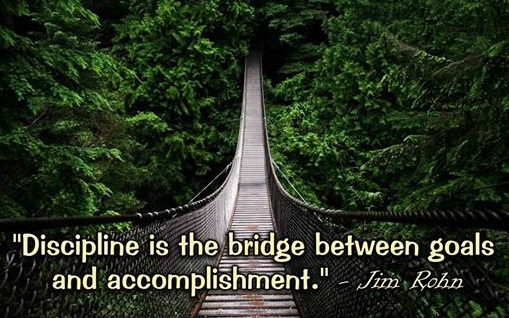
Discipline bridge

Here are a few ideas to help you achieve your fitness goals, whether you are triathlon training (like me), trying to get to your target weight, couch to 5k, or making it through an entire Beachbody DVD program like PiYo (my favorite).

1. Write down your plan.
Make your workouts part of your daily schedule/ routine – just like brushing your teeth, work meetings, appointments, etc. Consistently completing your scheduled workout appointment will build the habit – and improve your results.

2. Have a purpose to your workout.
This is especially true of endurance athletes who often log unnecessary or “junk miles” because they believe the volume of work will make them better. Not necessarily true. Regardless of your fitness goals, make sure your workout is aligned with them. Focus on your form and the quality of your workout. Learn to do it right before adding weight or intensity to your workout.

3. Try Habit Stacking. One clever way to sneak in your exercise is to associate it with something else already in your routine. I’ve made it a habit to hit my pull up bar after brushing me teeth in the morning. It only takes a minute. Brush teeth. Do pull ups. Boom! done!

4. Don’t ever give up.
Sometimes circumstances will block your workout schedule. Life happens. Healthy living is a journey intended to last a lifetime. Miss a day? Don’t do a double the next day, just move on to the next one. Short on time? Sneak in a partial workout, or modify it to get some activity in. Some is better than none. Building the habit is key and consistency grows over time. Eventually, exercise will be such a natural part of your life that you hardly have to think about it. Daily workout? Yep, that’s just like brushing your teeth…

Fitness

Ready to Workout? First Things First

prepared1

Make the most of your workouts by doing these simple things before you start.

Mind Your Mindset – If you are like me, exercise is a healthy release & distraction from the demands of daily life. Prepare your mind for the “mental health break” by switching your focus off the daily demands. Think about things that are true, noble, pure, lovely, admirable, excellent, or praiseworthy. Think about how good it feels to do something healthy for yourself, think about how good it feels when the workout is done – that glorious natural high that gets you through the rest of the day.

Workout with a Purpose – If you are following a specific training plan, do the workout! If you have goals you are trying to reach, pursue them vigorously. This is where you recall your WHY. Why am I exercising? Why is it important to me? At the same time, not every workout can be your best, or fastest, or strongest. Remember good form and the techniques you need for your particular exercise. Get good at the skills & techniques before trying to lift more, go faster, do more reps, etc. to avoid injury.

Budget Your Time – Sometimes work, circumstances, or just life gets in the way of your scheduled workout time, or forces you to cut it short. Some exercise is better than none. Take advantage of the time you have. However, if you are routinely cutting your workout short, then you likely are not budgeting your time effectively. Make the necessary adjustments to your day to maximize your workout time. Make it an appointment in your calendar that can’t be interrupted but for emergency.

Feed the Machine – Preparing for your workout includes having quality calories and hydration in your system. For especially long or intense workouts, this preparation needs to start well ahead of your workout appointment.

Muscle Activation – Don’t forget to warm up. Don’t do static stretching before your run, for example. Instead, begin slow and controlled with movements similar to what your workout will be. These movements will help the brain and muscles communicate better and prepare your body for the work ahead.

That may feel like a lot of work before your workout, but it should really only take a few minutes. Mental preparation is important. Get maximum results from your workout time with these simple preparation steps.

Fitness

Run Faster & Longer with Less Training Time

fast

One of my favorite parts of my healthy living lifestyle is learning and trying new things, whether it’s a nutrition “hack”, a training tip, a mindset/ attitude about food or exercise or rest or whatever. I’m very interested in learning how to maximize the results of training in the shortest possible time. I’m busy like everyone else, so training and exercise needs to fit into the rest of my hectic calendar. Early this year, I adopted a new training philosophy that turned my previous training methods upside down. Thanks to TriDot, Beachbody, and other reliable resources, I’ve been able to train smarter, in less time, be injury free, and achieve great results.

When looking for run specific training programs online, you can find all kinds of generic free plans, or worse, pay for a generic plan. Yikes! These programs don’t know YOU, they rely on self assessment of your ability (which is rarely accurate), and they almost always push too hard too fast leading to frustration, burnout, and injury. I know, because I spent nearly 5 years of triathlon training and endurance running trying many different training programs I could get for free from the ‘experts’. I want to share a few notes with you about run training to help you from having to learn the hard way as I have.

A key concept to understand about any training program is Progressive Overload. The gradual increase of stress placed upon the body during exercise training is progressive overload. The focus must be on the “gradual” and not the “increase.” When starting out, make the first workout easier than you think is necessary. Then keep increasing the workload incrementally over the previous effort. A rule of thumb is to keep your weekly workload to no more than 10% of the previous week and keep your long runs to no more than 25% of your weekly volume.

I like to measure my workouts by time, not distance, as it helps me to focus on how I feel – my form, breathing, heart rate, perceived effort, etc. Simply logging miles because the program says so is a waste of time and increases injury risk. Due to the strain on your body and lengthy recovery time, I recommend making your longest runs no more than 2 hrs. I made the mistake of including 20 mile training runs in my marathon training plan. These 3+ hour runs require many days to recover and do not fit the progressive overload training model. This overtraining of “junk miles” led to a nasty foot injury that nearly derailed my marathon experience. Lesson learned: Don’t get hung up on a mileage milestone like the “20 mile run”. Stick to progressive overload. Strong before long; fast before far. Let me explain.

Another key concept to understand is TriDot’s “Strong before long; fast before far” philosophy of training. Put simply, your ability to sustain effort over a long duration is dependent upon the strength you have built up in training. It’s perfectly logical. Over time in an endurance run, you will naturally slow down as you fatigue. Imagine graph with a vertical a scale of 1-100 of strength (power) and a horizontal scale of time in hours. If you are at a strength of 50 the duration of your effective stamina is far shorter than if your strength was 80. The curve will follow the same basic shape regardless of strength level. See chart below from TriDot.

So how does that translate to a training program? Thanks for asking. It means you need to build strength to be able to run faster and longer. The most effective way to do that is through interval training and functional strength training. Rather than do 5 shorter mileage runs a week and a ‘long’ run on the weekend, you should do only one or two different interval workouts, 1-2 short (30 min) functional strength workouts and maybe one longer easy run a week. Interval workouts come in many good formats, but the idea is to warm up first, then do repeated higher intensity run efforts with working rest between each set.

For example, I recently did a tough sprint interval workout consisting of 3 sets of 7 sprints (all out effort) for 20 seconds, followed by 20 seconds walking rest between each sprint then two minutes rest (light jog) between sets. It seems easy at first, but after four of five sprints you begin to see that the rest is not quite long enough to fully recover. This is a great workout because you teach your body how to go really hard, but then you rest before your body gives out on you. Muscular strength is built, lung capacity (VO2 max) is built, and all those fast twitch muscles are fully engaged. This is the kind of workout that takes 40 minutes and will make you much stronger and faster than simply logging mileage at a static pace.

My favorite functional strength training program comes from Beachbody’s PiYo. It’s a mix is Pilates and yoga that stretches and strengthens your whole body thru a series of dynamic movements using only your body weight. The stretching is amazing for my hamstrings and calves especially, but the core and balance work along with hip strengthening movements are what I believe has really helped my running the most. Whether you do PiYo or not, you need to incorporate some form of regular stretching and functional strength work in your routine. Thirty minutes a couple times a week will go a long way to helping you stay injury free too.

Long runs are still part of any endurance running program. You need to teach your body to run for increasingly longer durations with good relaxed form. The long runs should be run at an easier pace, (not race pace). You are working on efficiency with long runs. Speed will come with the interval sets. Just enjoy the cruise on the long runs. Remember to gradually increase duration week to week. There’s nothing wrong with taking a 1 min walking break during the long runs. It can be a mentally and physically therapeutic break in the monotony of the long workout.

I hope this helps. There’s so much more to cover in a good run training program. I’ve purposely not touched running form, nutrition, periodization in training, rest, or gear this time. Look for future posts on these topics or connect with me for free individual help.