Fitness

10 Reasons Why You Hate Working Out

Why You Don’t Like Working Out, And How to Improve Exercise Motivation

Why you hate it: It’s boring.

Solution: For some people, there’s nothing worse than running. Others hate swimming. And still others would rather get a root canal than lift weights at the gym. That’s why it’s important to try a variety of exercise styles to find what most appeals to you. There are tons of different types of workouts that appeal to all types of people. My guess is that if you think exercise is boring, you just haven’t found something you like. Try something new.

I can help you find interesting ways to get moving, or you can head to Beachbody On Demand for a selection of more than 40 different workout programs for all fitness levels and cover everything from weightlifting to yoga. Check out this guide to get an overview of the most popular options.

Why you hate it: It’s not fun to workout alone.

Solution: A good workout buddy can boost your enjoyment, and studies show that it can even encourage you to exercise more often. When it comes to working out, being accountable to another person can also go a long way towards keeping you on track with your schedule.

Working out in a group can multiply the benefits — especially when it comes to exercise enjoyment. Some have found great success with a group at the gym or in virtual/ online groups.  Conversely, working out alone CAN be fun and very rewarding if you have a personally compelling reason WHY you are working out. When your mission is greater than your fears & excuses, you will mysteriously find joy in the process – even when you are doing it alone.

IMG_0036

Why you hate it: It’s exhausting.

Solution: When you get home from a long day at work, all you want to do is plant your butt on the couch; trying to summon enough energy to exercise is the last thing on your mind. But research shows that physical activity can increase energy levels rather than sap them. Working out could be just what you need to have a productive end to your day.

But if you just can’t pick yourself up in the evening, pick a time of day to work out when you’re typically more energized, and when you can work out consistently. That last part is key. As the saying goes “the best time to work out is the time when you will work out.”

Why you hate it: You’re afraid you’re going to fail.

Solution: Sometimes it feels easier to avoid a task altogether than to risk falling short of your goal. If you never start trying to lose weight, then you can’t fail at it, right?

This is why Baby Steps are key: They help you work towards something you can actually achieve. “It’s important to set small, reasonable goals for yourself,” Dr. Leo Marvin says. Acknowledging your success can be a huge step forward in making the workout plan more enjoyable. When you hit a goal, celebrate it and set the next baby step.

Truthfully, the only way to fail on your healthy living journey is to never start, or to give up. This is a journey – filled with ups and downs, progress and setbacks. Embrace the journey and press on. Your future self will thank you for conquering your fear.

Why you hate it: You don’t like getting sweaty.

Solution: Unfortunately, in order to lose weight or gain strength, you’ll need to put in some hard work and get sweaty at some point. To avoid having to repeat your ‘get ready for work routine’, time your intense workouts to the beginning or end of your day.

Fortunately, you don’t have to subscribe to a gut-busting, sweat-soaked workout every single day. There are low-impact and low-intensity exercises that can give you a decent calorie burn without sweating buckets. Try activities like yoga or walking. Research suggests that you can gain major health benefits from a simple 30-minute walking routine. It’s enough to get your heart rate up, but won’t leave you soaked and smelly.

Why you hate it: It takes up too much time.

Solution: Whether you have a demanding job, no childcare, or both, it can be a challenge to find time to exercise. This is the most common excuse I hear for why people don’t exercise. To get over this hurdle, start small, and make exercise a non-negotiable must-do. Schedule it like you would a recurring business meeting. Start treating exercise like a key part of your day instead of a perpetual afterthought.

Break up your workout into short intervals throughout the day if you aren’t able to find a time to get everything done at once. I shared some excellent body weight workouts you can do anywhere anytime that really work. Try “habit stacking.” Simply add a few minutes of exercise on top of something else you already do every day, like doing some push-ups after you brush your teeth. You don’t have to work out for very long to notice a benefit (research shows that even a few minutes of intense exercise per week can improve cardiovascular fitness), but you do have to be consistent.

IMG_0453

Why you hate it: You can’t afford or don’t want to pay for a gym membership

Solution: Access to workout facilities and equipment can play a major role in sticking with a workout routine. So why add extra obstacles like a gym membership or tons of gear into the mix when they’re not necessary? Angie and I exercise in our living room with minimal equipment. Though we have different expressions after our workouts, it sure beats going to the gym! With Beachbody On Demand‘s extensive exercise library, which includes more than 600 fat-blasting workouts that can be done in a six foot-by-six foot area — we never get bored, and don’t have to leave home. Not only does working out at home save you the money of a gym membership, but it also lets you exercise on your own time.

Why you hate it: It’s embarrassing to work out in front of other people.

Solution: Exercise is supposed to relieve stress, not contribute to it. If you make yourself work out in an environment where you feel judged, it’s likely you won’t stick with it. This is a big reason why at-home workouts are so appealing. Being able to exercise in the privacy of your own living room removes the fear of being judged by others. It also allows you to slow down and learn new exercises at your own pace, instead of feeling pressured to do it right the first time.

Why you hate it: You’re really out of shape.

Solution: The first few days or weeks of a new exercise program are often the hardest. Even when you do muster the energy to work out, new moves often leave you feeling tired and sore in places you didn’t even know existed. To avoid this, take steps to prevent muscle soreness so you don’t get discouraged. Start slowly, and gradually increase your effort and intensity based on how you feel after each successive workout.

What you eat after working out can also optimize your recovery and help prevent soreness. Beachbody Performance Recover is made with 20 grams of protein to aid muscle repair and growth, and it contains pomegranate extract, which has been shown to reduce muscle soreness.

Additionally, listen to your body and schedule rest and recovery days when needed. Getting enough sleep, stretching, and eating well is extremely important. Try not to work the same muscle groups really hard on consecutive days.

Why you hate it: It’s all just too overwhelming.

Solution: The sheer volume of fitness advice in the world can be intimidating. That’s why it’s vital to not overcomplicate the process of getting started. Keep it simple: Think about what sounds like fun and really go for it. Just DO something. Yoda says, “Do or don’t do, there is no try.” Exercising is still work. Results take time and effort, so don’t give up when it gets difficult. Make the commitment to yourself to get on the healthy living train and stay there. One baby step at a time. Be stronger than your excuses. You can do this!

Special thanks to Mackenzie Lobby Havey and the Team Beachbody blog for doing the heavy lifting on this article!

Fortitude, Personal Development

Groundhog Day Wake Up Call

15179179_1616374175334137_7335960219990802116_n

I’m willing to bet you don’t know Phil Connors of Groundhog Day like I do. For more than 20 years I watched this hilarious classic movie every Feb 2. My poor wife has endured it with me most years, God bless her! We’re watching it tonight…again. You should watch it too, or else you won’t get my jokes.

In the movie, Phil (Bill Murray) was stuck in a rut. His results in life were the same despite his efforts to change. Eventually, Phil figured out what he needed to do to get unstuck and escape the hilarious nightmare of repeating the same day over and over.

I believe the same can be said for us in our healthy living journey. We really WANT to change and we say we want results, but nothing seems to work and we don’t know why. Just like Phil through most of the movie, we try and fail at all the tricks and gimmicks we can think of to get the desired results. It seems impossible so we give up, take the cursed groundhog hostage and drive ourselves over a cliff in a stolen truck. OK, maybe we don’t go that far, but you get the point. Only when Phil changed his mindset about his circumstance and took appropriate action did he finally win.

You can get unstuck once and for all. It’s not easy though. It takes work, discipline, sacrifice, and maybe even some pain, but the results are worth it.

It doesn’t matter what goal you want to accomplish or what you want to change in your life. Maybe you want to quit smoking or drinking. Maybe you need to quit looking at inappropriate websites, or wasting money at the casino. Maybe you need to lose the same 20 or 50 lbs you’ve lost several times over the years but can’t seem to keep it off. Maybe you need to quit giving up on (fill in the blank) every time it gets hard. You know what the thing is for you. You know change is required.

Let Groundhog Day be your wake up call.

Truth bomb: Change is hard. It’s in our nature to want things to be easy. Our whole world is bent on making everything easier. But the world does a lousy job of making it easy to change what really matters.  If you are ready to change for real, then you must first change your mind.

“Gee whiz Chad, that’s great advice, but how do I change my mind?” Listen, I’m no shrink or certified counselor, but I’ve been on a personal journey of change between my ears for a while now and I testify that you must CHOOSE to change. Just like Phil Connors did. Get to the very end of your rope and DECIDE once for all that what are doing, how you’re living, what you have, etc. is not what you want. It’s not what your ’20 years ago self’ envisioned for your today, and surely not what you want your future self to be. Are you there?

This is what Team Quadzilla is all about. Encouraging you to live with purpose, be your best self mentally, physically, spiritually, and sharing resources to inspire your journey. So don’t eat a table full of donuts or step in front of a semi because life is hard and you failed again. Get back up, make the hard choice(s), and be accountable to a trusted friend. You can do this! Hey, if Phil Connors can do it, you can too. Am I right, or am I right, or am I right? Right? Right? Right?

Fortitude, Personal Development

How To Break A Bad Habit

how-to-break-bad-habits-778x1024

If you set some significant goals this year, you might be feeling the challenge of sticking with them already. That’s especially true if you have a BAD HABIT holding you back.

Deeply ingrained habits are hard to break—but not impossible. There are a few steps you can take to break that bad habit, which I will explain now. Fasten your seat belts! This could change your life. 

Step 1. Admit the Challenge

Half the power of habits is our LACK OF AWARENESS. When we do become aware of a habit working against us, we have to ADMIT it’s inhibiting our progress. It doesn’t have to be life-threatening to be serious. It simply has to be standing in the way of your goals.

Most of us don’t take the time to sit still and THINK about such things. While I highly recommend some daily quiet time to focus your mind and take a regular sober self-assessment, start with remembering WHY you set the goal in the first place. Then think about what is holding you back. Write it down. Say this to yourself right now, with as much conviction as you can muster: “I have a problem with [fill in the blank].”

The good news is that whatever the impediment, you’re not alone. Other people have faced it, too. And from their success you can take courage that you can overcome it as well. All it takes is determination, a plan, and a trustworthy friend.

Step 2. Understand How Habits Work

Once the bad habit is identified, we need to understand how it works in order to break its power over us. A habit has three components:

The TRIGGER. This is often something we see with our eyes. But it can involve the rest of our senses as well.

The BEHAVIOR. Normally, we think of the behavior as the habit itself: overeating, procrastination, whatever. But it’s only our response to the trigger.

The REWARD. More than the physical sensation we experience, this is the dopamine hit the behavior produces.

The trick is that we begin experiencing the reward at the point of the trigger—even before we act. Your brain gives you a dopamine hit every time your eyes encounter something you associate with the reward. It’s like a feel-good credit card. The fun comes now; the bill comes later.

This where we get tripped up. Because it’s our human nature to look at, think about, and pay attention to is whatever we’ve done in the past that was immediately rewarded, we have to practice delayed gratification. Believe in your heart that the future reward is far greater than the instant & temporary reward. 

So think about the habit you want to break. Can you identify the trigger? This is where the sober self-assessment comes in handy. Everybody struggles with a warped view of themselves. Surprised? Most of us think too low of ourselves (I’m not good enough, not qualified, not worthy, etc.) Newsflash: YOU ARE A MASTERPIECE!

You were made for more than the bad habits and their empty and temporary rewards. An accurate view of yourself gives you the key to discovering your life purpose which will go a long way to helping you achieve your goals. Take encouragement from this verse from my favorite book: Ephesians 2:10 – “For we are God’s workmanship, created in Christ Jesus for good works, which God prepared beforehand so that we would walk in them.”

You’ve admitted you have a bad habit you want to change, you understand a bit more how habits work and hopefully have identified the trigger, and hopefully you’ve taken a sober self-assessment. Next let’s address MINDSET in clarifying what you want (the goal or good habit).

habits

Step 3. Flip the Switch

Have you ever tried really hard to NOT think about the thing you don’t want to (the trigger to the bad habit) only to find you are even MORE drawn to it? Yeah, me too. It’s normal. Thinking about defeating the bad habit will often send you right into the thing you are trying to avoid. The ‘trick’ is to REPLACE the thoughts with something else. This takes some practice, but it works.

It’s creating a new association for the trigger. You likely can’t make the trigger go away, so you have to relate the trigger to something positive instead. For example, say my bad habit is mindless eating. I always seem to be eating when I watch TV. Instead of not watching TV, I need to recognize that doing so is a trigger for me to eat snacks. So instead I need to consciously think of a new association when watching TV. Maybe I’ll chew gum, or drink water instead. Maybe I can do push-ups during commercials! That might also help minimize TV time!

Give your brain a new focus. In my example, the behavior was to eat snacks, but now you chew gum or drink water. Similar behavior, but much healthier. The point is to find something you can DO to change your focus to something different and better.

Another key to the mindset part of breaking bad habits is addressing your WHY. I talk/ write about this often because it is so powerful and effective to personal achievement. You need to have a personal, compelling reason(s) WHY you want to change. It’s not enough to say you want to quit smoking because it is bad for you. Why is it bad for YOU? What might quitting mean to your future self? How might quitting smoking affect your family? What will you do with the money you save from not buying smokes? Ask yourself these types of questions until you find the reason that truly motivates you to do this hard thing of breaking the bad habit. Go to this reason when you struggle, when you are tempted, when it gets really hard to resist. Your WHY will help keep you motivated.

If you’ve made it with me this far, I have good news. This is the home stretch. Just a couple more points to digest and you are on your way to slaying your bad habits for good! 

Let me be the first to agree with you that it is EASY to read (and write) about breaking bad habits. It’s really hard to actually DO it. I know. I share this info to encourage you, but also for my own good. I’m preaching to myself here.

By now you understand more about bad habits than you probably wanted, and maybe you’ve had some success in your journey to kick it already – which is awesome! 

But how do you keep up the good work over the long term? Thanks for asking. 

I have a couple ideas:

Track Your Progress. Not surprisingly, there are several free apps you can get to help you trade your bad habits for good ones. I prefer a journal and/ or written checklist or calendar to help me stay the course. Either way, it’s important to have a way to record your progress. It helps hold you accountable, serves as a reminder, and gives you a record of your journey so you can look back on it.

Tell a friend. This is REALLY important. Yep, it might be uncomfortable to share what you are doing, but a couple things happen when you get an accountability partner. One, it confirms to you that you are serious about replacing a bad habit. And two, you have a trusted friend who cares about you and will be there for you when times get tough. It’s really hard to replace bad habits all alone. Get someone to help you be accountable and maybe invite them to do it with you.

Never give up. Transformation won’t happen overnight. You must persevere through hard times. Keep an eye on the prize. Remember your WHY and how great it will be to have freedom from the “old you” or the bad habit that has kept you down for so long. When you hit a setback in your journey, remember that you don’t have to start all over. Just get back on track from where you left off. You can do it!

528739481-good-habits

Humans are bent toward addiction, to habit, routine, call it what you want. The key is to make sure that you are “addicted” to good habits – the ones that lead to the results you want and help you to take care of what is really important to you.

If this information is helpful or encouraging to you, would you please leave a comment? Feedback helps me to know I’m connecting with you and providing value to your life.

Fitness

Take Care of Your Hips – 9 Best Hip Stretches

If you are a Desk Jockey like me, this article is for you. Consider all the time you spend sitting at a desk or in your La-Z-Boy. For many of us, there are WAY too many of our waking hours spent drafting spreadsheets, attending meetings, posting on social media, watching Seinfeld re-runs, etc. That’s a lot of time for your hip joints to be stuck in a single position.

That’s a problem. “Elongated periods of sitting sends messages to certain muscles to stay turned on which keeps other muscles turned off,” says Beachbody fitness expert Cody Braun. “This creates an imbalance, which can immobilize your hips.” Your hips are built to move in almost any direction, explains Braun, and when they’re stiff, they don’t just make exercise more difficult; they also make you more prone to pain in surrounding joints — including the oft-troublesome lower back.

If your hip joints could use some TLC, help has arrived. All you need to do is spend a moment or two before and after your workouts or, heck, while watching TV — on a time-honored fitness activity that few of us do enough of: stretching. Below, I’ll show you some of the best hip stretches to improve flexibility and mobility, hopefully making up for all that time on your bum.

Why Hip Mobility Is Important

Quick physiology lesson: when a joint becomes stiff and immobile, the joint above and below it moves to compensate. So if you can’t move your hips, you’ll move your lower back instead.

Know anyone with lower back pain?

Oh, that’s right the overwhelming majority of Americans has lower back pain. If that includes you, you may benefit from making some or all of the hip stretches below part of your regular routine.

But mobile hip joints don’t just relieve pain. They’re also essential for walking, hiking, running, jumping, dancing, playing sports, and pursuing virtually any fitness goal safely and effectively. Want to develop stronger, more muscular legs? Hip mobility allows you to lunge and squat more deeply so you can reach your muscles’ potential. Want to avoid injury? Hip mobility improves range of motion so you can perform exercises more safely.

Anatomy of the Hips

The pelvis, that sturdy, bony structure that houses your hip joints, is the Grand Central Station of the body: dozens of different muscles, nerves, and tendons attach to and pass through it. The main ones you’ll focus on in your hip stretches are:

hip-stretches-anatomy-350

Hip flexors

These muscles extend roughly from your spine to your thighs. Their main job is to pull your thighs toward your chest. When they’re tight, they can pull the front of your pelvis downward, causing strain and pain in your lower back.

Hamstrings

This muscle group, including the biceps femoris muscle, runs along the backs of your thighs from your hips to your knees. Your hams oppose your quadriceps, bending your knee and helping to extend (straighten) your hip joints behind you.

Adductors

Located on the insides of your thighs, these muscles squeeze your legs together, and can cause tightness and limitation when you step laterally (sideways).

Glutes

The butt muscles work along with the hamstrings to extend, or straighten, your hips, and, with the aid of the abductors on the outsides of your hips, raise your legs out to the sides.

Stretch these four main areas to help increase mobility, and you’ll be good to go.

2 Main Types of Stretching and When to Use Them

The 9 hip stretches below, all culled from the extensive library of full-body workout programs available at Beachbody on Demand, offer two different stretching techniques: dynamic and static stretches, which you should use at different times.

Dynamic stretching

These are large, full-range movements of one or more joints at once, often performed standing and sometimes while walking or jogging. They resemble old-school movements you might have done in calisthenics or gym class: arm swings, leg swings, high-knee walks. You usually count off reps, rather than time, on dynamic stretches, which work best as a warm-up activity before a workout, or any time you need a pick-me-up boost throughout the day.

Static stretching

These movements are slower and mellower; they’re the reach-and-hold stretches you might see in a basic yoga or stretching class. Forward bends, knees-wide butterfly stretches, the pigeon, or the figure 4 pose in yoga are classic examples.

Often you’ll perform static stretches seated or lying down, and focus on breathing slowly and deeply to facilitate relaxation sometimes for several minutes at a time. Static stretches can be very effective at loosening you up, but they also inhibit performance in the stretched muscles for a short time afterwards. So they’re best reserved for after a workout, or as an any-time stress reliever just not right before a workout involving the muscles you’re stretching.

9 of the Best Pre- and Post-Workout Hip Stretches

Together with a healthy diet and a great workout program, the following hip stretches will leave you feeling and looking your best.

Seated Leg Cradle

leg cradle

Type of Stretch: Static

Benefits: Lengthens and relieves tension in the glutes, adductors, and hamstrings.

Appears in: Yoga Studio – Hip Opening With Faith

• Sit on the floor with both legs extended straight in front of you, feet flexed.

• Keeping your back straight, draw your right knee toward your chest, and try one or more of the following variations:

  1. Holding your right knee in your right hand, grab your right ankle with your left hand and draw it toward your chest as far as you can.
  2. Draw your right ankle toward your chest and rest your lower leg inside the creases of your elbows, bending them to draw your leg as close as you can to your chest.
  3. Draw your right ankle toward your chest and wrap your arms around the lower leg, interlacing your fingers with your knee inside the crease of your right elbow and your foot inside the crook of your left. Hug your lower leg toward your chest as far as you can.

• Keeping your back flat, your chest up, and both feet flexed, rock slightly left and right.

• Hold for 30 seconds, then repeat on the other side.

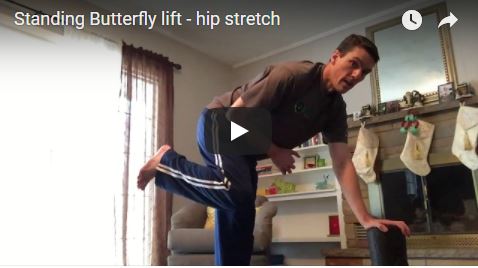
Standing Butterfly Lift

standing butterfly

Type of stretch: Dynamic

Benefits: Activates the glutes while improving mobility in the hip capsule (the ligament that attaches the leg to the pelvis) and adductors.

Appears in: Yoga Studio – Get Well Rounded With Elise

• Stand with your feet shoulder-width apart about 18 inches behind two yoga blocks positioned on the floor at the tallest height.

• Hinge forward at your hips and place your hands on the blocks. (If that’s too difficult, use a taller surface like a chair instead.)

• Bend your right knee, pulling your heel towards your right glute, and keep it there throughout the set. This is your starting position.

• Keeping your back flat and standing leg straight, lift your right knee as far out to your right side as you can.

• Reverse the move, lowering your right knee until it’s close to your left.

• Repeat for 10-12 controlled repetitions, then repeat on your other side.

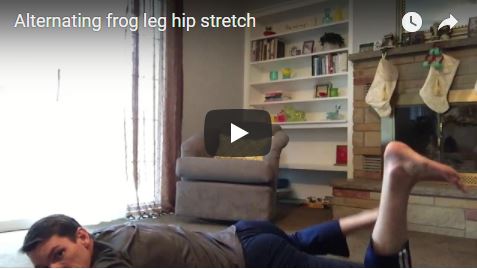
Frog Alternate Legs

frog leg

Type of stretch: Dynamic

Benefits: Stretches the adductors and improves mobility in the hip capsule.

Appears in: Shift Shop  Shift Mobility

 Lie face down, bend your knees about 90 degrees, and spread them as wide as you can. Fold your hands under your forehead to relax your upper body.

• Keeping your knees bent, slowly roll your right thigh inward, lowering your right foot toward the floor.

• Try to tap your right foot on the floor, and reverse the move, repeating on your other side.

• Continue slowly alternating sides for 30 seconds.

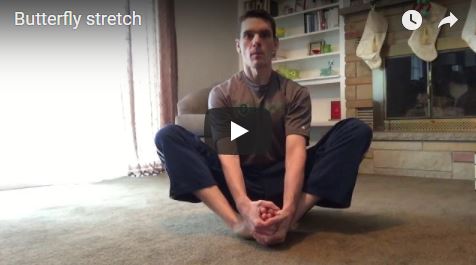
Butterfly

butterfly

Type of stretch: Static

Benefits: Lengthens the adductors and reduces tension along the entire spine and back of the neck.

Appears in: 21 Day Fix  Yoga

• Sit on the floor upright with your legs bent, the soles of your feet together, and your knees spread wide.

• Keeping your knees spread as wide as possible, take hold of your feet and slowly pull your forehead towards the floor.

• Hold this stretched position for 30-60 seconds.

Scorpion

scorpion

Type of stretch: Dynamic

Benefits: Stretches the quads and hip flexors, and activates the glutes.

Appears in: P90X3  Dynamix

• Lie on your stomach, with your legs straight, and arms extended out to the sides, forming a “T.” Your palms should face down.

• Keeping your left leg straight, lift your right leg off the floor, bend your right knee, and cross your right foot behind your left, continuing up toward your left hand.

• Try to tap your left hand with your right foot, and return to the starting position.

• Continue for 30 seconds, and repeat on your other side.

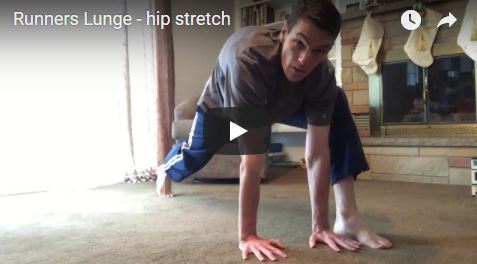
Runners Lunge

runners lunge

Type of stretch: Static or dynamic, depending on how long you hold the position.

Benefits: Stretches the adductors and glutes.

Appears in: 21 Day Fix Extreme  Yoga Fix Extreme

• Assume a pushup position: hands and balls of your feet on the floor, both shoulder-width apart, and your body straight from head to heels.

• Step your right foot to a point just outside your right hand. (Your right knee should be near your right shoulder.) If possible, lower your elbows to the floor.

• Hold for 15 seconds, and reverse the move to return to the starting position

• Repeat the entire sequence on your other side.

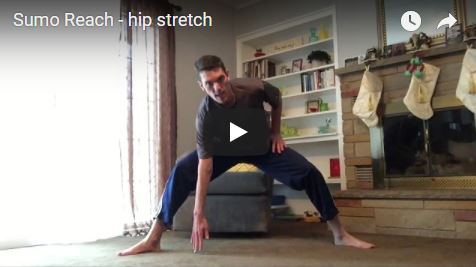
Sumo Reach

sumo reach

Type of stretch: Dynamic/static

Benefits: Strengthens the glutes and shoulders, stretches the adductors, opens the hip joints, and rib cage.

Appears in: Insanity  Max Recovery

• Assume a wide stance, turning both feet out about 45 degrees.

• Keeping your torso upright, and your core engaged, bend your knees and lower your trunk as you extend both arms straight out to the sides, palms down, forming a “T.”

• Perform three pulses downward, sinking more deeply into this wide-stance (“sumo”) squat each time.

• Keeping your back long and your arms straight, bend your torso to the left as far as you can, and try to place your left palm on the floor near the inside of your left foot.

• Look up at your right palm and hold the position for a 5- to 10-count.

• Brace your core to return to the starting position, and perform the entire sequence on your other side.

Groiner

groiner

Type of stretch: Dynamic

Benefits: Stretches the glutes, adductors, and hip flexors.

Appears in: P90X3  Dynamix

• Assume a pushup position: hands and balls of your feet on the floor, both shoulder-width apart, and your body straight from head to heels.

• Step your right foot to a point just outside your right hand.

• Sink into the move for a one-count, lowering your hips as far as possible.

• Return your foot to the starting position.

• Continue for 30 seconds, then repeat on the other side.

Too tough? Perform the move with your hands elevated on yoga blocks.

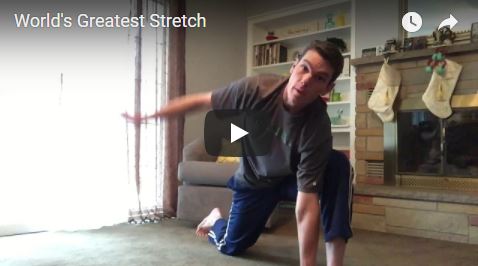
World’s Greatest Stretch

worlds greatest

Type of stretch: Static

Benefits: Lengthens the hip flexors, adductors, chest, and rib cage.

Appears in: Clean Week: Mobility

• Start in a deep lunge with your right foot forward, your left knee and top of your left foot on the floor behind you, and your palms about hip distance apart on the floor inside your right foot.

• Keeping your back flat and both arms straight, lift your right hand up toward the ceiling as high as you can, twisting your torso into your right knee.

• Hold for 10 seconds, then return your right hand to the floor.

• Maintaining the same position in your lower body, lift your left arm up towards the ceiling in the same manner.

• Hold for 10 seconds, then slowly return your left hand to the floor.

• Switch sides, and repeat the sequence.

Thanks to Andy Heffernan and the Beachbody Blog for doing the heavy lifting on this article.

faith, Fortitude, Personal Development

How To Find Real Rest

Are you tired? I’m not just talking about fatigue from a poor night of sleep. I mean REALLY tired. Exhausted. Feeling the weight of the world on your shoulders kind of tired. Feeling overwhelmed or terribly inadequate for the endless work to be done. Wondering when life will get easier and better, but also believing such a life is not meant for you. Ugh.

tired

Aren’t we all craving real rest? This morning I was reminded of familiar words about rest. Jesus said in Matthew 11:28-30, “Come to me, all you who are weary and burdened, and I will give you rest. Take my yoke upon you and learn from me, for I am gentle and humble in heart, and you will find rest for your souls. For my yoke is easy and my burden is light.”

I’m no Bible scholar, but a few things stand out to me as I read this.

Notice the command: “Come to me.” Jesus hasn’t moved or left me behind. I moved. I need to come to him. Jesus is here for me now. Requires action on my part. I see it like this: Stop doing what you are doing now because it’s not working for you. You are tired – probably from working yourself to the bone to earn favor, acceptance, love, and rest. Stop it. Just come to Jesus. He knows we ALL are weary and burdened and tired. He offers us rest from it all. But how?

Verse 29 says, “Take my yoke upon you.” Not an egg yolk, duh. This yoke ties two oxen or horses together so they can plow the farmers field or pull a carriage. The yoke goes over the backs of the beasts so the burden is distributed more evenly between them.

yoke

The yoke doesn’t work when the beasts are of different sizes, because the burden is not equally distributed. So when you hear the expression “unequally yoked” in reference to relationships, this is what they are referring to. If a couple is not equal in their beliefs or world view, the relationship will be unnecessarily burdened and both people will suffer. I digress.

Jesus is saying we need to disconnect from the yoke of slavery from the burdens we carry on our own and connect to his yoke which is lighter and easier. Jesus offers to carry our burdens and lighten our load. Doesn’t that sound nice?

Instead, we are more like slaves to the burdens we carry. That’s right, I said slaves. The burdens are like chains that weigh us down. They have mastery over our moods and behavior. We surrender to the burdens like a prisoner or slave does to his master.  But when we are connected to Jesus we learn his ways. We learn how to really “let go” of things that enslave us so we can live in peace and find rest.

Why do we look everywhere else for peace and rest? Books and lectures from motivational speakers don’t really help us here. Drugs and alcohol certainly won’t help us find rest. Risky behavior, gambling, porn, career, etc. don’t offer the real escape we desire from the burdens we all carry. Only Jesus can give us real rest.

It’s counter-intuitive to believe the answer is so easy. We expect it to be really hard. To get what we REALLY want (peace, rest, comfort, joy, love, acceptance, etc.) we believe we must work really hard to earn it. The lake house, the perfect spouse, the superhero physique, the dream job, you name it. These things will never satisfy. And all our striving for these things is like chasing the wind. The peace, rest, and love we desperately long for is right in front of us. Jesus is calling us to simply come to him.

I write this because it’s very personal to me – a journal entry from a while back. I share it here because I hope you will find encouragement and rest for your weary soul. I’m preaching to myself too. I’ve spent most of my life striving and working and trying to earn acceptance, approval, and rest. It’s utterly exhausting. And I fail so much! I still wrestle with a “performance mindset,” but I’m seeing the benefits of really letting go, answering Jesus’s call to come to him and surrender my will to his.

I’m telling you, it’s way better. It’s real freedom. Peace that surpasses understanding. Joy even. Yeah, life is still hard sometimes. There is still work to do and bad things to go through, but having Jesus with me through it all makes it so much easier. But you may not believe me. That’s OK. You probably won’t believe that being connected to Jesus is the best way to live until you try it for yourself. Jesus invites you to come to him. He will give you rest – and so much more. Will you answer his call?