faith, Fortitude, Personal Development

The Pain of Expectations

IMG_0386

Do you ever feel really stressed, frustrated, bitter, or just in a dumpy mood? Maybe so much so that you feel exhausted? These feelings describe the opposite of happy. And we just want to be happy, don’t we? I’m going to share something with you from my personal journal that may offend you. I have an answer to this stress & exhaustion that may surprise you. It surprised me and I wrote it. That happens to me on occasion. I believe deep insight, inspiration and encouragement come to me by simply taking the time to write. You should try it. You might be surprised at the wisdom you have locked up in your mind. I digress.

I believe that a major cause for our stress, exhaustion, frustration, and general unhappiness is because we blame others for our unmet expectations. We have expectations (from deep in our mind, but rarely verbalized) that others will do as we please, or as we need (expect), for surely our needs are simple and reasonable. The trouble is that we subconsciously tie the satisfaction of our expectations to our happiness. If others don’t comply, we get upset. And it’s all their fault. They must fix it (behave differently) for us to be happy. This of course, is a terrible way to live.

To have our mood and attitude dependent upon the actions & behavior of another must be exhausting and stressful. A sober self-assessment is required for we will never easily acknowledge this is really happening to us. The truth is, we can never control the behavior of another, but we can always control our own behavior. We are in charge of ourselves.

love-always-wins

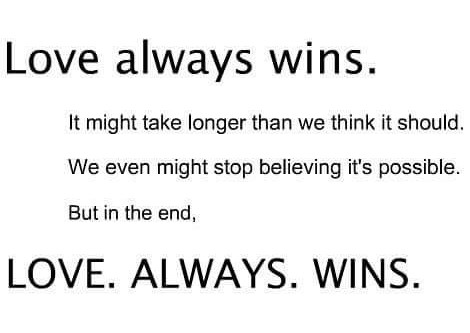
So someone close to us is not behaving well according to our opinion of the matter. (Isn’t the expectation we hold more strict for those closest to us?) What are we to do? We should take the advice of Jesus. He said we are to simply love. Love always wins. Being frustrated, bitter, stressed, and exhausted will not make another’s behavior improve. But love will. Yep. #lovealwayswins

One of the hardest things to do is to love those who hurt us or make us upset. Jesus said we are to love our enemies and pray for those who persecute us. To me that means to love those who make us upset. Jesus said we are to do to others what we would have them do to us. What would happen if we really did this?

images

I believe this is just like what Jesus has shown us. Jesus loves us with an incredible love, an everlasting love, a love that pursues us even when we turn away, even when we are bad. Jesus died for us because of his great love for us and so we could be with him in heaven for all eternity. There is no other way for us to get heaven than by the loving sacrifice of Jesus. His love is entirely selfless and perfect in every way. We don’t deserve his love and we can never earn his love. Our response to that love is to love Jesus in return. To obey him and know him and serve him. Not because we must earn his favor (because we already have it), but because we’re so grateful for Jesus’ love and loving him is a natural way to express gratitude.

In the same way, If we can REALLY love those who frustrate us like no other (aka those closest to us), if we can just love the people we expect to behave a certain way to make us happy but always fail, I believe the natural response of that person will eventually be to love us back out of gratitude for the grace, mercy and love shown them. That’s just how it works. #preachingtomyself #easiersaidthandone

As followers of Jesus, we are to be known by our love. We can draw others to Jesus by simply loving them. We can make our relationships better by simply loving those close to us despite their flaws and frustrations. It’s our choice. Stop waiting for others to “get it together” and just love them. I’m willing to bet that if we love others well, our frustrations will decrease and our overall happiness will increase. Love always wins.

faith, Family

Men Matter

dr.-dobson's-june-newsletter
I want to deal with what is happening to men within the culture at large.

Have you noticed that the “women’s movement,” as it is now called, has again declared all-out war on men? It is pervasive and comes in the form of ridicule, resentment, belittlement, hostility and anti-male bias. It is not a new phenomenon, of course, having begun with a vengeance in the late 60s and 70s. It was then called the “women’s liberation movement.” In the present permutation, various organizations and leftist groups are still out there teaching hate and conflict between men and women. They include Planned Parenthood and other pro-abortion groups, the mainstream media, the entertainment industry, gay and lesbian advocates, liberal universities, and a host of other leftist entities.

Several months ago, former candidate for president, Hillary Clinton, said that she lost the election because men had browbeaten their wives by insisting that they vote for her opponent, Donald Trump. Could she really be serious? Do women not have minds of their own?

The contemporary version of the war between the sexes is an effort to make men look like fools. They are depicted as immature, impulsive, selfish, weak, and not very bright. Evidence of that campaign can still be observed in almost every dimension of the culture, especially in the entertainment industry. Television commercials slam the message home night after night.

The tiresome formula involves a beautiful woman who is intelligent, sexy, admirable, self-assured and well dressed. She encounters a man who brags and blusters and says crazy things. He is ignorant, balding, and almost always overweight. The stupid guy, as I will call him, quickly disgraces himself on screen, at which point the woman sneers or walks away. There are hundreds of these ads on TV today and have been out there for many years. Watch for them on the tube. They are constantly changing, but here are some actual commercials that appeared for all the world to see.

1. The stupid guy approaches a gorgeous girl in a bar who is pouring a Heineken beer into a glass (guess what is about to happen). She smiles seductively. He is so flabbergasted by her beauty that he overflows his own glass. The announcer then calls this “a premature pour.” There is little doubt about the nasty meaning of that one.

2. The stupid guy loves driving his Acura so much that he puts lipstick all over his mouth, musses up his hair, and twists his shirt. He is trying to make his wife think he’s been with another woman, but when he gets home, she looks at him scornfully and says, “You’ve been out driving again, haven’t you?” He sighs and looks down, like a little boy caught stealing candy.

3. The stupid guy is too scared to talk to a sexy woman in a bar, so a friend writes inane notes to prompt him. He suggests to the dumb dude that he write unintelligent messages to the woman, such as, “Hi” and “How are you?” Ultimately, the girl leaves with the writer, and the stupid guy is left bewildered and alone at the bar.

4. The stupid guy is a flabby man in his forties who is standing alone in front of his bedroom mirror. He is not wearing a shirt. Then he tentatively tries on his wife’s bra. At that moment, his wife comes through the door. The cross-dresser is caught. She fails to notice the bra and asks him something about sports. Relief spreads across his face. The caption then reads, “Some questions are easier to answer than others.”

5. The stupid guy is trying to impress an attractive girl with his knowledge of professional football, but she corrects his facts at every turn. He then reminds her that he was a “guard” for the Pittsburgh Steelers. The girl says sarcastically, “Larry! You were a parking lot attendant!”

6. Three stupid guys are standing together at a cocktail party when they spot a beautiful woman in red. One of the men identifies her to the others as “the chairman’s wife, Mrs. Robinson.” (The setting recalls a Mrs. Robinson in the movie, The Graduate, who seduced actor Dustin Hoffman.) At that point, the woman sidles over to one of the men and says, “Have you ever seen something and you just knew you wanted it?” The stupid guy swallows hard and trembles. This is his big moment. Then Mrs. Robinson grabs his “Killian’s Irish Red” beer and walks away.

7. This is the most disgusting advertisement I have seen. The stupid guy is a trainer in a gym who is showing a good-looking girl how to toughen her “glutes,” referring to the muscles in her buttocks. He stands before her and begins to grunt and strain, bending slightly forward and grimacing. One wonders if there is something terrible happening in his shorts. Then he reaches behind to retrieve a walnut that he has apparently cracked with his rear end. Somehow that disgusting ad was supposed to make the viewer want to rent a car from Budget. It didn’t work for me, I assure you.

Television commercials are not the only culprit. Today’s sitcoms are downright awful. They blast away at traditional masculinity, much like wrecking balls crashing into a building scheduled for demolition. After taking many direct hits, the structure begins to crumble. As I write, there is not a single example of a healthy family depicted in a sitcom that focuses on a masculine, heterosexual guy who loves his kids and is respected by his wife. Not one!

You’ll note that the polarity of the stupid guy ads is never reversed. Not in a lifetime will viewers see a corpulent, unattractive, sloppy woman lusting after a good looking man in an ad or sitcom, who shows disdain for her as she does something embarrassingly foolish. Men, however, don’t seem to notice that the joke is on them. Perhaps they (we) have been desensitized by fifty years of male bashing.

Agencies conduct exhaustive market research before committing millions of corporate dollars to advertising programs such as these. So, what is going on here? Is it possible that men, especially male beer drinkers and sports car enthusiasts, actually like being depicted as dumb, horny, fat, nerdy, and ugly? Apparently, they do. We also have to assume that guys are not offended when they are made the butt of a thousand jokes. But why? Women would not tolerate that kind of derision.

Are you old enough to remember the sitcom, “All in the Family?” It was based on a redneck clod named Archie Bunker and his mousy wife, Edith. Humor was used to make a fool out of him, and by extension, every conservative man in the country. From there, primetime television programming has evolved into today’s fare, most of which features profane, sexually explicit cohabitants who meander through one outrageous episode after another. The lead characters are usually men with the giddy mentality of fourteen year-old boys. Hollywood writers use these programs to snuff out every vestige of male pride and crush it beyond recognition.

This leads us to ask, why does it matter? Why should we be concerned about the war between the sexes? There are two primary consequences. First, it effectively weakens the family and damages the institution of marriage. Common sense tells us that dividing the population down the middle and pitting one sex against the other couldn’t be healthy for intimate relationships. I am convinced that the war is related to the huge divorce rate in today’s world. Many women are reluctant to marry, or stay married to, sniveling men who lack the confidence to lead or care for their wives and children. That hurts everyone.

The second consequence of the war between the sexes is that it warps the minds of children. Do we not know that kids are capable of noticing that men are often made to look like fools in the wider world? They watch the sitcoms too, after all. I’m convinced that many boys and girls learn to disrespect the men in their lives. They should be taught to look up to their fathers and want to emulate them. Boys, especially, need to learn how to become men by watching strong, loving dads who take the time to mentor them. A high percentage of babies are born out of wedlock and have no masculine influence in the home. History teaches that the young and vulnerable suffer most from the ravages of war. In this case, both boys and girls have been wounded by the ricochet.

Remember that the war is not just being waged between men and woman. It is culture wide. Kathleen Parker wrote, “Today’s boys grow up in a bizarrely hostile environment. They’re told to be tough, not to cry, to be a man. It is an ironic insult in a culture that devalues men and fathers. They’re bullied by schools intolerant of boy behavior, told they’re less special than girls, and left by too-busy parents to the tutelage of peers, media, and superheroes who wreak havoc to settle scores.”

Michael Thompson, coauthor of Raising Cane, said that many women are hoping against hope that their sons won’t turn out like their husbands.

Journalist Megan Rosenfeld said that our sons are seen as politically incorrect. “[They] are universal scapegoats, the clumsy clods with smelly feet who care only about sports and mischief.”

Harvard psychologist William Pollack said women consider boys to be creatures who might “infect girls with some kind of social cooties.”

No discussion of boy-bias would be complete without addressing the discrimination against males evident in American public education. Again, William Pollack said succinctly, “It sounds terrible to say, but coeducational public schools have become the most boy-unfriendly places on earth. It may still be a man’s world. But it certainly isn’t a boy’s world.”
And finally, Christine Hoff Sommers, the most passionate and effective defender of boys, echoed these concerns in her outstanding book, The War Against Boys, How Misguided Feminism is Harming our Young Men. She says this is “a bad time to be a boy in America because of the bias against them in our educational institutions.”

In conclusion, let me acknowledge the obvious. Not all men are worthy of respect. Some are jerks. Some drink heavily and abuse their wives and children. Some are severely into pornography or are inveterate gamblers. Some waste the family’s resources. Some are lazy. Some are unfaithful and chase after other women. Some have other serious faults. I haven’t intended to make excuses in this letter for such individuals. Every situation is unique.

I can tell you this. Women often hold the keys to a man’s confidence, his willingness to work, to live a clean life, and even to influence his commitment to Jesus Christ. If you belittle and disrespect him at home, you and your children could be the losers for it.

If that is your circumstance, please don’t be offended by what I have written. But I urge you not to get carried along by the radical feminist’s universal hostility to men—all men. Their anger is not a good thing. If you join their movement, you might hurt your sons and daughters and destroy your marriage. For all the women out there whose husbands are basically good men, but perhaps they are just not good enough in your eyes, you might want to reexamine the guy you married. He could have some hidden qualities you might have overlooked. Search for the hidden virtues and see what could show up.

Even more to the point, you should never underestimate the power of prayer. My grandmother was married to a man who was not a believer. He told her to do what she wanted with their 6 kids, but to keep him out of spiritual matters. She prayed and fasted for him for more than 40 years without response. Then he became critically ill at 69 and asked his wife specifically to pray for him. He said he wasn’t afraid to die, but it was so dark. She knelt at his bedside and he gave his heart to Jesus Christ. Two weeks later, he died with a testimony on his lips. We are going to see him again on the other side. You have no idea what answers to prayer God might have in store for your wounded marriage. I have seen miracles happen many times.

Be encouraged, fathers. Your children will be impacted by your godly guidance and care if you take the time to invest in their lives. Happy Father’s Day!


This letter may be reproduced without change and in its entirety for non-commercial and non-political purposes without prior permission from Family Talk. Copyright, 2017 Family Talk. All Rights Reserved. International Copyright Secured. Printed in the U.S.A.

faith, Family

6 Qualities of an Encouraging Parent

untitled

Sometimes I find an article that fits Team Quadzilla well so I’m compelled to share it with you. As we approach Father’s Day, I thought this encouragement about parenting was timely. For those who don’t care much for the Bible, I will only ask that you read this anyway because there are some practical ideas to help us be better parents. Enjoy this content from Dr. Eric Scalise.

What is encouragement and why is it so essential for maintaining healthy marriages and families? Encouragement represents positive influence, to literally give courage to someone—not waiting until it’s deserved or asked for, but taking initiative when things are difficult and uncertain. There are many synonyms one could use: to give support, confidence or hope to another; to hearten, cheer, uplift, inspire, motivate, vitalize, embolden, or rally. The impact can be far reaching and often makes a difference when relationships begin to falter. Even the neuroscience gives credence to this dynamic. Criticism and negativity release harmful stress hormones, inhibit concentration, diminish the brain’s executive functioning, and tend to create knee-jerk reactions vs. calm and rational thinking.

The Bible provides a wonderful example of a life fully lived under this principle. His name was Barnabas and there are several lessons we can draw from his story. Here are six worth considering:

1. The first thing about an encourager is that he or she is practical.

Barnabas arrives on the scene in Acts 4:36-37. He was just a regular “Joe” (Joseph, a Levite), but his nature was so uplifting and encouraging, that the Apostles changed his name to fit his character—Bar (the Son of) Encouragement. He sold some land and laid the money at the Apostle’s feet. Here were the leaders of the first century church who were trying to take care of widows and orphans, and what they needed at the time were financial resources—so practical in the moment.

While attending to someone spiritually is always appropriate and helpful, we shouldn’t neglect looking for ways to encourage the people we love on practical levels as well. Perhaps you have heard the saying, “We can become so heavenly-minded, we are no earthly good.” Imagine if your nickname was “husband” or “wife” of encouragement. . .father or mother of encouragement. Sometimes our spouse or child needs a simple hug, an act of service, a helping hand, or an arm around the shoulder that says, “I love you.” Let your encouragement today be practical.

2. Second, an encourager is a risk taker.

In Acts 9:26-27, Barnabas stood up for Saul when no one else believed in his conversion and everyone was still afraid of him. He took a risk when others wanted to reject Saul for his behavior. Love has the ability to look past brokenness and pain, even sinful choices, and still see God at work in the midst of a situation. Loving and caring for someone can be risky and often requires us to be authentic and to move beyond our comfort zones.

Marriage and parenting offer numerous opportunities to forgive when we have been hurt or a sacred trust has been violated. Being open and transparent in a marital or family relationship, especially in sharing thoughts, emotions, hurts, etc., can mean stepping “outside the box.” There are no guarantees that we will be immune from the storms of life on this side of eternity. However, in Christ, risks are frequently overcome with steps of faith. Take a risk today—encourage your loved one by being vulnerable.

3. Third, an encourager is committed.

When Barnabas was sent to Antioch and got among the people, the Scriptures says he began to encourage them with everything he had (Acts 11:19-24). The words describe him as having a “resolute heart.” In the Greek, this is translated as prosthesis kardia, which literally means, “purposed in the will.” This was part of who Barnabas was and his sense of calling.

In the same way, when we walk down the aisle with someone and pledge vows, or choose to bring a son or daughter into the world, we need to be committed as “all in” when it comes to our own role and responsibilities as spouses and parents. In some ways, success can be defined as falling down seven times and getting up eight. Great marriages and great parenting are not created by 50-50 commitments, thinking this represents a whole relationship, but after two people each give 100%. When Cortez landed in the New World, he burned his ships; it signified there was but one direction in moving forward. Find a way to encourage your spouse or a child that indicates you’re all in.

4. Fourth, an encourager is others-centered.

Shortly after arriving in Antioch, Barnabas turned his thoughts toward his good friend, Saul (Acts 11:25-26). He knew he had to share this blessing and not be consumed with his own sense of self-importance. Inviting others into your journey underscores the reality that we were created by God in relationship and for relationship. He never intended for us to be alone and take a solo flight through life.

Marriages and families are composed of individuals who each have their own set of expectations, desires, hopes, dreams, and plans. We all need to grow in the practice of “relational gift-giving.” Here, we can proactively choose to focus on our spouse or child and consider what would bless them, please them, support them, and draw them closer to God. Encourage your loved ones and make this moment, this hour, this day, a celebration of who they are.

5. Fifth, an encourager is available.

While in Antioch, the Lord commissioned and directed the very first missionary journey (Acts 13:1-3). Immediately, Barnabas and Paul made themselves available and were sent out. This implies an ongoing state of preparation and anticipation, a willingness to lay down one’s own ideas, plans, and desires for the benefit of others. Leaders often understand more can depend on a person’s availability before God than necessarily his or her ability.

Making ourselves available to the Lord, as well as to our spouses and children, can open up the doors of opportunity for deeper relationships, ministry, healing, and transformation. For many, time is one of the most valuable commodities in today’s fast-paced world. Sharing it with a loved one is a wonderful gift. It says, “Here I am. . .for you. . .for us. To listen, to care, to serve.” The power of presence should never be underestimated. God can accomplish much in a marriage or family through vessels who are fully yielded to Him. Be an encourager and offer yourself in love.

6. Finally, an encourager is patient.

During the first missionary journey, Barnabas took along his young cousin, John Mark, who later left them in the middle of the trip. On a subsequent journey when Paul suggested they visit all the churches that were started, Barnabas wanted Mark to join them once again. However, Paul accused Mark of desertion and he and Barnabas had such a significant argument, they parted company. Paul took Silas and Barnabas took Mark (Acts 15:36-40). Barnabas remained patient and longsuffering with his cousin.

There are times when loving someone means standing with him or her in the middle of major mistakes and shortcomings. The first descriptor of love is that it is patient (1 Cor. 13). We have all probably heard incredible testimonies that speak to the power of a praying mother. Who will continue believing in, advocating for, and supporting our spouse, son or daughter? Encourage that family member through your unwavering, patient, and unconditional love.

As I close, let us examine the fruit of encouragement. In 2 Timothy 4:11, Paul is imprisoned and in the twilight of his life on the earth. He says, “Only Luke is with me. Get Mark and bring him with you, because he is helpful to me in my ministry.” Later, in 1 Peter 5:13, when writing to the believers who were scattered because of persecution, Peter says, “She who is in Babylon, chosen together with you, sends you her greetings, and so does my son Mark.”

Even though we hear very little about Barnabas or Mark after they parted company with Paul, these verses reveal that somewhere along the journey, this young disciple “made it.” The one who had failed miserably, moved into a place of responsibility and maturity. Here, we see the two preeminent Apostles of the first century who are strongly supportive and complimentary of Mark—Paul saying he was useful to him and Peter referring to him as a son in the faith. God Himself allowed Mark to write one of the four Gospels. Although Scripture is largely silent on the matter, I believe the fact that Mark was able to work through whatever issues he had, was because Barnabas refused to give up on him and was willing to stick it out during the long journey.

You potentially may be the most influential person in your spouse’s or child’s life. . . in the best position to support, pray for, believe in, and journey with him or her in all the ups and downs. The gift of encouragement is within you right now. May the outcome be as equally transforming as it was for John Mark.


faith, Family, Fortitude, Personal Development

How to Stop Worrying

worry

I recently woke up inspired to write the following journal entry. I hope it encourages and challenges you as it does me.

Worry says, “God is not big enough.” This is a terrible accusation for the Ultimate Creator of the universe who holds all things in this mighty hand. There is a pride and selfishness in worry that we don’t recognize. When we worry, we assume the burden only for ourselves. No one, not even God, can help us. “I must bear it all alone,” is the message we tell ourselves. Boo-hiss!

You, O Lord have saved us from our sins. Your promises are certain, you never fail. You tell us to cast our cares upon you, to take your light & easy yoke upon us, to trust you in everything, because you love us even more than we could love ourselves.

conquer2

When we worry, it should send a signal to our hearts that there is something to surrender to the Lord. The work of surrender should be our task – not the enduring or solving the thing we worry about. The surrender is the real work though. We must conquer our mind which wars against surrender and favors of our natural carnal survival instinct.

To be clear, surrender is not “giving up.” Not even close. I think of it more like a transfer of burden from me to God. Don’t we all want some help with our burdens?

worry 2

Worry is often an unreasonable fear, in my opinion. Fear of the unknown, fear of the future. Remember being a kid when your parents made you try something new? It was scary at first, but since you trust them, you eventually go for it. Inevitably, it turns out great. So much fun, so much easier, so good, so tasty, etc. As parents we do the same for our kids too. We want the best for them. We want them to experience all that is good and enjoyable in the world. So why do we not trust God to do even more for us? Have we forgotten that God is our Heavenly Father and we are his beloved children?

Also, have you noticed how many times we worry over things that NEVER happen? We worry about the “what ifs” and we come up with some crazy ones, don’t we? Well, stop it. God wants the best for us and he actually knows the future. We should trust God and surrender our worry to his capable hands. #preachingtomyself

The antidote to worry is trust. Trust is only as good as the object for which the trust is placed. We have a choice to make in the face of our worry. Will we choose to trust ourselves and our lousy capacity to predict the future, or will we trust in God who knows everything and is in control of everything?

I understand that trusting in God is not easy. Denying ourselves is the opposite of our human nature. I often wrestle with surrendering to God. I’m convinced that my way is better. After I fall on my face, I realize that God’s way is always best. It might be hard to deny myself and trust God, but it is always best. Honestly, it is such a great relief to leave the “worrisome things” to God. It’s the best stress reliever.

FAST FORWARD 2 WEEKS

God has a funny way of making these type of life lessons come to life in real time for me. As I’m preparing this article, I get tested with some pretty stressful work situations. Instead of practicing what I’m writing about, I revert to my old nature and experience high stress with all its symptoms – exhaustion, irritability, upset stomach, loss of appetite and stress eating at the same time (yeah, that really happens to me), anger, depression, etc. Yuck. After a few days, I calmed down enough to realize what I was doing and made a mental adjustment. I transferred my burden to the Lord. Just as he promises, everything changed in my outlook. The circumstances haven’t changed, but my attitude and mindset did. Praise the Lord! The chains of the stress are gone and I am free to be my very best through the circumstances. #workinprogress #underconstruction

For some of you, these concepts about God may seem foreign or even offensive to you. You may have ways to cope with your worries that don’t involve God, and would say I’m weak or crazy. Maybe so. But I’m willing to bet that someday your way will not work, and whenever your Jedi mind trick or destructive behavior you try leaves you still looking for answers, remember this: The truth is that God loves you more than you could ever know, and His great desire is for you to know Him and experience all the freedom, peace, and good that comes with a personal relationship with God. I would love to talk with you about how you can enjoy freedom from worry through a personal relationship with the God of the universe.

     “Humble yourselves, therefore, under God’s mighty hand, that he may lift you up in due          time. Cast all your anxiety on him because he cares for you.” – 1 Peter 5:6-7

faith, Family

6 Truths About The Role of Moms

009

“All that I am or ever hope to be, I owe to my angel mother.” Abraham Lincoln 

“Only God Himself fully appreciates the influence of a Christian mother in the molding of character in her children.” Billy Graham 
“My mother was the most beautiful woman I ever saw. All I am I owe to my mother. I attribute all my success in life to the moral, intellectual and physical education I received from her.” George Washington

Mother. Every time a child is born – so is a mother. It has often been said that in that one moment when a mother sees her newborn child for the first time, nine months of discomfort and the hours of pain and delivery are completely forgotten. An innate eternal bond is instantly formed that transcends and eclipses all other relationships.

The word “mother” is used nearly 300 times in the Bible, and Strong’s Concordance tells us that the word literally means “an intimate relationship… that bestows benefits on another.” 

M-O-T-H-E-R. When thinking about how to describe those benefits bestowed on us by our mothers, this acronym gives us just a glimpse of the depth of who she is.

Mom. The proverbial “first word” of an infant often sounds like “ma” or “mama”. This strong association of that sound with “mother” has persisted in nearly every language on earth. Mum in the United Kingdom. Mam in the Netherlands. Mata in India. Even Mama in Chinese. No matter how big, or fast, or powerful an athlete is, when they look into the camera what do they always say? “Hi mom!” Affection and love poured out in one simple word – “mom” – no matter what the language.

Others. When you really think it through, many mothers work as many as 90 hours a week. Their job description defies logic. A loving hand on a skinned knee. Miles and miles of taxi service. Applause from the 3rd row of the 2nd grade school play. Tears of joy at graduation – whether it is from dance class or college. Dishes…diapers…drama…discipline. Duties all selflessly performed by the person we affectionately call “mother”.

Teacher. Solomon admonishes us to “forsake not your mother’s teaching”(Proverbs 1:8 ESV). He goes on to say that those teachings are “a graceful garland for your head and pendants for your neck” (Proverbs 1:9 ESV). Life changing lessons taught during late night talks that shape our character for the rest of our lives.

Honor. The first commandment ever given with a promise was “honor your father and mother” (Ephesians 6:2 ESV). Why? “That it may go well with you and that you may live long in the land” (vs 3). The word honor literally means “weighted value”. We are to deeply honor and profoundly value our mothers – and in turn God promises blessings poured out on our lives.

Encourager. Your greatest cheerleader will always be your mom. No matter what. Through thick and thin. Good and bad. Laughter and pain. I am reminded of the instruction Paul gave when he said “encourage the fainthearted, help the weak, be patient with them all” (1 Thessalonians 5:14 ESV). Sounds like what a mom does all of the time!

Relationship. What’s interesting is that of the seven phrases Jesus uttered on the cross, one of them was directed to the person who gently pushed Him into public ministry (John 2), and searched frantically for Him when she thought He was lost (Luke 2). She stood with Him at Calvary when virtually everyone else deserted Him. Jesus acknowledged her, and provided for her, even during His tortuous death on the cross of salvation. “When Jesus saw his mother and the disciple whom he loved standing nearby, he said to his mother, “Woman, behold, your son!” Then he said to the disciple, ‘Behold, your mother!’ And from that hour the disciple took her to his own home.” (John 19:26-27 ESV). A relationship begun in a manger… confirmed in a miracle… and declared even in mourning. Mother.

My friend Ann Voskamp eloquently puts it like this; “God said ‘I need someone who can shape a soul and find shoes on Sunday and get grass stains out of Levis. Someone with a heart strong enough for toddler tantrums and teenage testing, yet broken enough to fall on her knees and pray, pray, pray.’ So God made a mother.”

Life didn’t come with a manual – it came with a Mother.

This Mother’s Day, love her. Cherish her. Honor her…that it “may go well you and that you may live long in the land.” 

It just might turn your life – and hers – around. – Dr. Tim Clinton via www.drjamesdobson.org